Sure, it's not "we no speak americano" but this video will be much more helpful when it comes to studying for your test tomorrow. Thanks Claudia for sharing this!
Monday, November 15, 2010

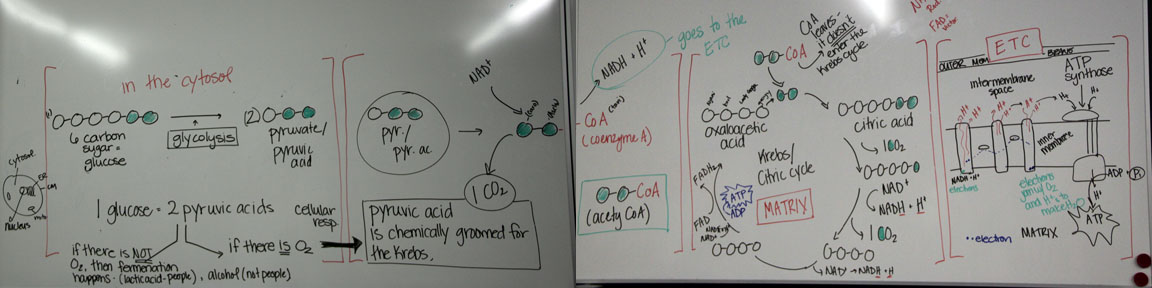
Cellular Respiration Review
Today students made cellular respiration review posters. Below is a photo of the diagram from the board. Click the picture to make it larger. You have a test tomorrow on cellular respiration (Ch. 9).
Friday, November 12, 2010
Elodea & Snails Wrap Up & Cellular Respiration Review
Today we wrapped up the Elodea & Snails lab as well as used student generated questions to play trivia.
Below are the resources we used to help us learn about cellular respiration.
The Oxidative Phosphorylation Song (mp3 file).
The Oxidative Phosphorylation Song Lyrics
Citric Acid/Krebs Cycle Animation
The Electron Transport Chain Video (click "The Movie")

Below are the resources we used to help us learn about cellular respiration.
The Oxidative Phosphorylation Song (mp3 file).
The Oxidative Phosphorylation Song Lyrics
Citric Acid/Krebs Cycle Animation
The Electron Transport Chain Video (click "The Movie")
Tuesday, November 9, 2010
Elodea & Snails
Today we set up the elodea and snails lab. Homework: Read section 9.1 and take notes for a reading quiz.
Monday, November 8, 2010
Cellular Respiration Intro
Today we introduced cellular respiration by playing trivia to take notes. Tomorrow we will do a lab to see the connection between photosynthesis and cellular respiration.

You do not need to conduct the experiment. You only need to write down your hypothesis, the independent variable, the dependent variable, the set up for your control and an outline of your experimental design.
Homework: Click on the here. It will take you to a screen that looks like the one below. Click on the second title "Carbon Transfer Through Elodea & Snails."
 Read the problem statement. Once you have read this, click the X in the top right corner of the box, to close this screen. Follow the directions to explore the lab. Once you have clicked on all of the items, you will be able to click on the procedure button. Follow the instructions and answer the "lab notebook questions." You can either type your answers into the boxes and print your responses or you can write your answers on a sheet of paper.
 Click on the second title "Carbon Transfer Through Elodea & Snails."
 Read the problem statement. Once you have read this, click the X in the top right corner of the box, to close this screen. Follow the directions to explore the lab. Once you have clicked on all of the items, you will be able to click on the procedure button. Follow the instructions and answer the "lab notebook questions." You can either type your answers into the boxes and print your responses or you can write your answers on a sheet of paper.
You do not need to conduct the experiment. You only need to write down your hypothesis, the independent variable, the dependent variable, the set up for your control and an outline of your experimental design.
Tuesday, November 2, 2010
Photosynthesis Review
Today students made review posters for photosynthesis that included the details from a photon of light hitting photosystem II all the way through the production of 2 G3P molecules which get turned into glucose.
Tomorrow/Thursday we will be starting chapter 9 - cellular respiration.
Friday is your test on chapter 8.
Tomorrow/Thursday we will be starting chapter 9 - cellular respiration.
Friday is your test on chapter 8.
Monday, November 1, 2010
ETC recap and intro to the details of the Calvin Cycle
Today we reviewed the light dependent reactions before moving on to the details of the Calvin Cycle. Click the picture below to link to the Calvin Cycle animation we watched in class.
Homework: bring markers, colored pencils and any other art supplies you'd like to use for a mini project in class tomorrow.
Homework: bring markers, colored pencils and any other art supplies you'd like to use for a mini project in class tomorrow.
Monday, October 25, 2010
The Light Depedent Reaction
Today we spent the bulk of class learning about the light dependent reactions. Click on the picture below to link to the video clip we watched in class.

You have no homework over academic travel. It would be ideal if you reviewed your photosynthesis notes before coming to class on Monday.
You have no homework over academic travel. It would be ideal if you reviewed your photosynthesis notes before coming to class on Monday.
Friday, October 22, 2010
Photosynthesis Overview
Today we did an overview of photosynthesis. Homework: Read section 8.3 and take notes for a reading quiz.
Thursday, October 21, 2010
F Block Lab Data

Above is your data table, it was also emailed to you after class. Please make a graph, include the labels and write a two paragraph discussion.
D Block Lab Data

D Block Lab Data:
You need to make a line graph for the data above. Make sure to label the graph. You also need to write a two paragraph discussion INTERPRETING your data and discussing sources of error.
Wednesday, October 20, 2010
G Block Lab Data
Today we used the pH probes to examine the effect of various concentrations on the rate of diffusion. Homework: Use the data below and create a graph of what happened over the course of three minutes to the pH of the water (outside the dialysis tubing). Click the picture to make it larger. You can make your graph on paper or in Excel. Make sure to label the x and y axis properly and make a title.
You also need to write a two paragraph discussion. This is due on Friday.
 Click the picture to make it larger. You can make your graph on paper or in Excel. Make sure to label the x and y axis properly and make a title.
 You also need to write a two paragraph discussion. This is due on Friday.
Tuesday, October 19, 2010
Dialysis Tubing Lab Procedure
Today students learned how to work with the dialysis tubing and set up their experiments to examine the relationship between concentration and the rate of diffusion.
Homework:
Write a detailed procedure for the lab you did in class today. You will be giving your procedure to another group to use tomorrow. You will be graded on how successfully the other group can follow your procedure.
Homework:
Write a detailed procedure for the lab you did in class today. You will be giving your procedure to another group to use tomorrow. You will be graded on how successfully the other group can follow your procedure.
Monday, October 18, 2010
Test Today
Today students had a test on Chapter 7: Parts of the cell, osmosis and diffusion.
The big news is: the dialysis tubing has now arrived! Instead of pushing ahead with photosynthesis, we're going to do a lab tomorrow using the Vernier probes we learned how to use last week.
In this lab, you will look at how concentration effects the rate of diffusion.
Homework:
Make a prediction for how you think concentration effects the rate of diffusion. In your prediction make sure to include a definition of diffusion and an explanation of the principle.
In addition, you will need to write a procedure to use in class tomorrow for this experiment. Below are some experimental guidelines:
Each pair will have:
a Vernier pH Probe and lab base
Three unknown samples to test
dH2O
You should set your probe to follow the guidelines we did in class (3 minutes, 20 samples per minute).
The big news is: the dialysis tubing has now arrived! Instead of pushing ahead with photosynthesis, we're going to do a lab tomorrow using the Vernier probes we learned how to use last week.
In this lab, you will look at how concentration effects the rate of diffusion.
Homework:
Make a prediction for how you think concentration effects the rate of diffusion. In your prediction make sure to include a definition of diffusion and an explanation of the principle.
In addition, you will need to write a procedure to use in class tomorrow for this experiment. Below are some experimental guidelines:
Each pair will have:
a Vernier pH Probe and lab base
Three unknown samples to test
dH2O
You should set your probe to follow the guidelines we did in class (3 minutes, 20 samples per minute).
Friday, October 15, 2010
Today we started chapter 8: Photosynthesis. To get us started, we watched this video:
While some of you might call it lame or childish, it's catchy and has some helpful hints about photosynthesis. Click here to see the video of the Earth breathing that we watched.
Homework: Study for your test on Monday.
While some of you might call it lame or childish, it's catchy and has some helpful hints about photosynthesis. Click here to see the video of the Earth breathing that we watched.
Homework: Study for your test on Monday.
Thursday, October 14, 2010
Learning to use Vernier Labquest Probes
Today we learned how to use the Vernier Labquest Probes. We will be doing an experiment using dialysis tubing to examine the rate of diffusion in relationship to the molarity of a solution. As soon as the dialysis tubing arrives we'll go back to osmosis and diffusion and do the lab. In the meantime, we'll move forward to chapter 8: Photosynthesis.
Homework: Study for your test on Monday.
Homework: Study for your test on Monday.
Tuesday, October 12, 2010
Osmosis and Diffusion
Today students had a different type of reading quiz, where they needed to used Bloom's Taxonomy to write their own reading quiz questions.
After the reading quiz we finished the chapter 7 packet by wrapping up osmosis and diffusion.
Homework: Click the picture below to be taken to the website you'll use to complete your homework.
After the reading quiz we finished the chapter 7 packet by wrapping up osmosis and diffusion.
Homework: Click the picture below to be taken to the website you'll use to complete your homework.
Monday, October 11, 2010
Cell Membranes
Today we recapped the parts of the cell and learned about the structure of a cell membrane.
Homework: Read section 7.3 and take notes for a reading quiz.
Homework: Read section 7.3 and take notes for a reading quiz.
Friday, October 8, 2010
Cell Part Want Ads
Today we finished the overview of the cell parts and students worked on making want ads for the cell.
Homework: Finish your want and complete the test corrections. You can find instructions for test corrections here or read the post below this one.
Homework: Finish your want and complete the test corrections. You can find instructions for test corrections here or read the post below this one.
Thursday, October 7, 2010
Test Corrections Due Monday
On Monday your test corrections are due. What does this mean?
You need to rewrite each question you got wrong AND write the correct answer.
For example if you got Question #6 wrong, you would write:
#6. When a protein becomes denatured it changes from the _____ structure to the _____ structure.
d. tertiary to primary.
The more questions you got wrong, the more work you have to do.
You need to rewrite each question you got wrong AND write the correct answer.
For example if you got Question #6 wrong, you would write:
#6. When a protein becomes denatured it changes from the _____ structure to the _____ structure.
d. tertiary to primary.
The more questions you got wrong, the more work you have to do.
Tuesday, October 5, 2010
Test Today
Today students had a test on Chapter 2. Some people did really well, other people not so much. Tomorrow we will be starting a new unit on cells with Chapter 7.
There is no homework tonight.
There is no homework tonight.
Monday, October 4, 2010
Catalase Lab Analysis & Review
Today students answered the following questions about the lab we did on Friday. Once they finished analyzing the lab, they were able to start on a review packet for the test.
1. Based on what you know about the guidelines for writing a scientifically accurate title, write a title for this lab.
1. Based on what you know about the guidelines for writing a scientifically accurate title, write a title for this lab.
Below is a table of raw data from all three classes for the Potato Catalase Lab. Note: all units are in cm. Be sure to include units in your answers for all the questions.
| sample | Hot | Room Temp | Cold |
| 1 | 0.1 | 5.8 | 3.4 |
| 2 | 0 | 4.7 | 5.3 |
| 3 | 0.1 | 5 | 6 |
| 4 | 4 | 8 | 6.8 |
| 5 | 0.1 | 3.9 | 5.9 |
| 6 | 0 | 2.8 | 4.2 |
| 7 | 0 | 4.5 | 8 |
| 8 | 0 | 5 | 4.8 |
| 9 | 0.2 | 4.5 | 5.5 |
| 10 | 0.1 | 3.5 | 5 |
| 11 | 0.2 | 4 | 1.5 |
| 12 | 0 | 2 | 5 |
2. What is raw data?
3. True or False: you should include raw data in your discussion section of your lab reports? (circle one answer).
4. What is the average height of the bubbles for the hot group _______________?
5. What is the average height of the bubbles for the room temperature group _____________?
6. What is the average height of the bubbles for the cold group ______________?
7. What do you suppose could be an explanation for the anomaly in sample 4?
8. What biological concept did this lab illustrate? Write your answer in at least three complete sentences.
Saturday, October 2, 2010
Test on Tuesday
For your test on Tuesday you are responsible for all of chapter 2. You should also review the handout on enzymes, as this information is not in your book. The test will have multiple choice questions, true/false and open response questions. Approximately 80% of the points will be for questions from chapter 2 and the other 20% of points will relate to the lab work you have done so far.
Friday, October 1, 2010
Potato Catalase Lab
 Today students examined the effect of temperature on potato catalase, which is an enzyme. Using hydrogen peroxide which reacts with catalase to create bubbles, students were able to see that when catalase is denatured by a heat source, no bubbles are formed.
On Monday we will be analyzing the data on the height of the bubbles from all three sections. We will also be reviewing for the chapter 2 test, which has now been moved to Tuesday.
Homework: study for your test.
Wednesday, September 29, 2010
Plan for the rest of the week
Today we will be finishing the macromolecules lab and starting to learn about enzymes. On Friday we will do a mini lab looking at the effects of temperature on enzyme function. On TUESDAY you will have a test on Chapter 2.
Homework: Click through the PowerPoint below. Write the procedure for Friday's lab in your notebook.
Homework: Click through the PowerPoint below. Write the procedure for Friday's lab in your notebook.
Potato catalse lab
View more presentations from ilanasaxe.
Tuesday, September 28, 2010
Testing for Macromolecules
Today we started testing various foods for macromolecules. Tomorrow (or Thursday) we will continue testing and wrap up the experiment.
Homework: none.
Click the picture to read about what we did in class and for more information on macromolecules in food.
Homework: none.
Click the picture to read about what we did in class and for more information on macromolecules in food.
Wednesday, September 22, 2010
Turnitin.com
You will need to check your TASIS email for the class ID and password to join turnitin.com.
You can read a sample lab report here. NOTE: The discussion in that sample lab report is not long enough. It's only a little bit more than half a page, with 1.5 spacing. Your discussion needs to be an entire page.
In case you forgot to read what a discussion should include, read the excerpt from the Colby College Guide to Writing Scientific Papers, below.
You can read a sample lab report here. NOTE: The discussion in that sample lab report is not long enough. It's only a little bit more than half a page, with 1.5 spacing. Your discussion needs to be an entire page.
In case you forgot to read what a discussion should include, read the excerpt from the Colby College Guide to Writing Scientific Papers, below.
Here, the researcher interprets the data in terms of any patterns that were observed, any relationships among experimental variables that are important and any correlations between variables that are discernible. The author should include any explanations of how the results differed from those hypothesized, or how the results were either different from or similar to those of any related experiments performed by other researchers. Remember that experiments do not always need to show major differences or trends to be important. "Negative" results also need to be explained and may represent something important--perhaps a new or changed focus for your research.
A useful strategy in discussing your experiment is to relate your specific results back to the broad theoretical context presented in the Introduction. Since your Introduction went from the general to a specific question, going from the specific back to the general will help to tie your ideas and arguments together.
Remember that your discussion should have a title that follows the guidelines we talked about in class. I don't want to read anything titled "Salty Pea Lab."
Tuesday, September 21, 2010
Properties of Water
Today we learned about many of the properties of water. For homework, you need to read section 2.3 and take notes for a reading quiz.
Just a reminder that your discussion is due on Friday.
Just a reminder that your discussion is due on Friday.
Monday, September 20, 2010
Seeds and Salt Wrap Up
Today we wrapped up the seeds and salt experiment. We talked about how to present data and interpret it. One Friday you will need to turn in a one page discussion of your results. Read about what is included in a scientific discussion here.
Guidelines for writing your discussion:
It should be typed, using size 12 Time New Roman Font, with 1.5 spacing.
It should only be one full page.
You must bring a printed copy to class AND submit a copy to Turnitin.com (we will go over this in class on Tuesday).
Late work will NOT be accepted.
Homework Due Tomorrow:
Read section 2-2 and take notes for a reading quiz.
Guidelines for writing your discussion:
It should be typed, using size 12 Time New Roman Font, with 1.5 spacing.
It should only be one full page.
You must bring a printed copy to class AND submit a copy to Turnitin.com (we will go over this in class on Tuesday).
Late work will NOT be accepted.
Homework Due Tomorrow:
Read section 2-2 and take notes for a reading quiz.
Thursday, September 16, 2010
The Nature of Matter (starting chapter 2)
NOTE: This post is for Thursday and Friday because on Friday we are running a Wednesday schedule.
Today students collected data from their pea experiments. Some of the peas have started to germinate! After collecting the data and talking about the feasibility of collecting data everyday, we moved on to start chapter 2: The Nature of Matter.
Students were given a guided notes sheet to help organize their notes. We watched a short video clip on carbon dating. Click here to see it.
Homework:
Watch the video clip below and use the information to complete the table in your notes packet that compares ionic and covalent bonding.
After watching the video, finish reading section 2-1 in your book to complete the questions on Van der Waals forces etc. You also need to finish the check-in questions for homework. You should use all of section 2-1 (pages 35-39) in your book to help you review.
This is due on Monday.
Today students collected data from their pea experiments. Some of the peas have started to germinate! After collecting the data and talking about the feasibility of collecting data everyday, we moved on to start chapter 2: The Nature of Matter.
Students were given a guided notes sheet to help organize their notes. We watched a short video clip on carbon dating. Click here to see it.
Homework:
Watch the video clip below and use the information to complete the table in your notes packet that compares ionic and covalent bonding.
After watching the video, finish reading section 2-1 in your book to complete the questions on Van der Waals forces etc. You also need to finish the check-in questions for homework. You should use all of section 2-1 (pages 35-39) in your book to help you review.
This is due on Monday.
Monday, September 13, 2010
Designing an Experiment
Today students had a pop quiz on the reading assigned for homework as well as the controls and variables material they learned last week.
After the quiz, we looked at the blog (see post below) to look back at what was required to properly complete the homework. Many students then realized that they did not follow the directions properly, especially where they needed to have five test groups and five samples. In this one instance, that's actually OK, as it is a helpful teaching tool to understand what it means to follow directions and have a strong experimental design.
We worked as a class to come up with the following set up.
Hypothesis: If seeds are placed in various concentrations of NaCl then there will be variation in the rate of growth.
Independent Variable: [NaCl]
Dependent Variable: change in mass of seed
Set up: Figure 1: The red dots represent seeds, which were placed in the center of a 9cm Petri Dish (in F block, a 5.2cm Petri dish was suggested).
Group 1: The control group. 20ml of distilled water is added to the petri dish.
Experimental Groups (* the salt concentrations were different in each class * make sure you write the correct concentration for your class).
Group 2:
Group 3:
Group 4:
Group 5:
Homework, due tomorrow, 2 parts:
PART 1: Complete the rest of the experimental set up. Important questions to think about are:
* What will your light source be? How close will the plants be to the light? How can do make sure all the plants receive equal light?
* How often will you collect data?
* Water evaporates. What will you do to compensate for this?
PART 2: Make a data table that you could use to record your data from this experiment. You do not need to create data, just make the table.
After the quiz, we looked at the blog (see post below) to look back at what was required to properly complete the homework. Many students then realized that they did not follow the directions properly, especially where they needed to have five test groups and five samples. In this one instance, that's actually OK, as it is a helpful teaching tool to understand what it means to follow directions and have a strong experimental design.
We worked as a class to come up with the following set up.
Hypothesis: If seeds are placed in various concentrations of NaCl then there will be variation in the rate of growth.
Independent Variable: [NaCl]
Dependent Variable: change in mass of seed
Set up:
 Figure 1: The red dots represent seeds, which were placed in the center of a 9cm Petri Dish (in F block, a 5.2cm Petri dish was suggested).
Group 1: The control group. 20ml of distilled water is added to the petri dish.
Experimental Groups (* the salt concentrations were different in each class * make sure you write the correct concentration for your class).
Group 2:
Group 3:
Group 4:
Group 5:
Homework, due tomorrow, 2 parts:
PART 1: Complete the rest of the experimental set up. Important questions to think about are:
* What will your light source be? How close will the plants be to the light? How can do make sure all the plants receive equal light?
* How often will you collect data?
* Water evaporates. What will you do to compensate for this?
PART 2: Make a data table that you could use to record your data from this experiment. You do not need to create data, just make the table.
Friday, September 10, 2010
Controls and Variables & Designing an Experiment
Today, with the help of the Simpsons, we learned about controls, variables and better ways to design an experiment.
On Monday you will need to turn in your experimental design planning sheet.
First read about the experimental method here.
Second complete the planning sheet. BE DETAILED! One experimental design will be chosen from each period for us to do in class. What's your incentive for having a good design? Aside from bragging rights, you will receive a rare homework pass which will excuse you from a homework.
A few reminders about your experiments:
1. We must be able to do the experiment in class.
2. The experiment should not take more than 3 class periods, including data analysis.
3. Look at the class schedule and remember that we have class hikes next week, so the schedule is:
Monday- Tuesday-Hikes- Thursday-Wednesday.
4. No organism with a spinal cord may be used.
5. We are not finding a cure for a disease, the purpose of this is to practice experimental design.
6. It must be a controlled experiment
7. You should have four test groups (and a control group) and each test should be done at least five times.
On Monday you will need to turn in your experimental design planning sheet.
First read about the experimental method here.
Second complete the planning sheet. BE DETAILED! One experimental design will be chosen from each period for us to do in class. What's your incentive for having a good design? Aside from bragging rights, you will receive a rare homework pass which will excuse you from a homework.
A few reminders about your experiments:
1. We must be able to do the experiment in class.
2. The experiment should not take more than 3 class periods, including data analysis.
3. Look at the class schedule and remember that we have class hikes next week, so the schedule is:
Monday- Tuesday-Hikes- Thursday-Wednesday.
4. No organism with a spinal cord may be used.
5. We are not finding a cure for a disease, the purpose of this is to practice experimental design.
6. It must be a controlled experiment
7. You should have four test groups (and a control group) and each test should be done at least five times.
Wednesday, September 8, 2010
Microscopes
Today we started working with microscopes. After reviewing the parts of the microscope, students practiced looking at different tissue samples, drawing them and viewing the samples under various powers.
Homework: none.
Tuesday, September 7, 2010
Characteristics of living things & Graphing
What are the characteristics of living things? We all know that a computer isn't alive, but what about viruses? Why aren't viruses considered by many scientists to be 'non-living.'
After tackling the characteristics of living things, we moved on to another important science skill: the ability to interpret data. This is something we will be doing all year long.

Homework: Finish the graphing practice.
After tackling the characteristics of living things, we moved on to another important science skill: the ability to interpret data. This is something we will be doing all year long.

Homework: Finish the graphing practice.
Monday, September 6, 2010
First Day of School Homework
So that I know that YOU know where the blog is and that you can check it,
click on your name. Your only homework for tonight is to write down
the website that your name links to.
D Block
Milena
Flavia
Gabriela
Francesca
Anderson
Isabel
Faye
Heidi
Bogdan
Isabella
Virginia
Francisco
Claudia
Nabila
Svetlana
Layla
F block
G Block
click on your name. Your only homework for tonight is to write down
the website that your name links to.
D Block
Milena
F block
| Natalia |
| Vitaly |
| Phillip |
| Finnian |
| Luis |
| Adriana |
| Alberto |
| Assial |
| Margarita |
| Karl |
| Caro |
| Victoria |
| Carla |
| Assel |
| Georgy |
| Njani |
G Block
| Edis |
| Maria |
| Fernanda |
| Katy |
| Arianna |
| Lucianna |
| Jan |
| Nicholas |
| Andrea |
| Kristina |
Welcome to Biology
Hopefully you have gotten over your initial confusion of being asked, "what sound does a raisin make."
This blog will be a place for you to find out about homework, connect with other websites that can help you prepare for tests and keep you on track in class.
Please check it nightly.
Biology is the branch of science devoted to the study of life. The course starts with building an understanding of the scientific method before moving on to investigating the cell and energy processes at the cellular and system levels. Moving forward we will delve into cellular reproduction, genetics and cancer. At last we will focus on evolution, populations and the environment. Throughout this course students will work on the following four sets of scientific inquiry skills:
This blog will be a place for you to find out about homework, connect with other websites that can help you prepare for tests and keep you on track in class.
Please check it nightly.
Biology is the branch of science devoted to the study of life. The course starts with building an understanding of the scientific method before moving on to investigating the cell and energy processes at the cellular and system levels. Moving forward we will delve into cellular reproduction, genetics and cancer. At last we will focus on evolution, populations and the environment. Throughout this course students will work on the following four sets of scientific inquiry skills:
A. Make observations, raise questions, and formulate hypotheses.
B. Design and conduct scientific investigations.
C. Analyze and interpret results of scientific investigations.
D. Communicate and apply the results of scientific investigations.
Office Hours: By appointment only. The best way to set up a time for extra help is by email, I can be reached at ilana.saxe@tasis.ch.
Grading:
Homework 15% Tests/Projects 30%
Quizzes 15% Lab work 15%
Semester grade: Coursework…..75% Final Exam……25%
Year grade: 1st semester…..45% 2nd semester...…55%
Integrity:
Homework: Homework will be assigned almost every night and be incorporated into the following day’s class. A late assignment defeats the purpose of completing it. Therefore, late homework will not be accepted and will be graded as a zero. Assignments include, but are not limited to: worksheets; problem sets; readings; preparing for a discussion/presentation etc.
Make-up Work: You are responsible for obtaining missed assignments. If you know in advance you will be missing class for co-curriculars, an appointment etc. you should notify me in advance at least 2 days in advance.
Late Work Policy: As previously stated, late homework is not accepted. Late projects will be accepted up to three calendar days after the due date. However, each day that the project is late, 10% of the grade will be lost. After the third day the project will no longer be accepted.
Extensions: Extensions will not be given except in the event of extenuating circumstances, so plan your time wisely.
Attendance: Attendance is mandatory at all class meetings. You are expected to arrive on time in be in your seat with your homework and your notebook on your desk. A pattern of tardiness will be regarded as not meeting the expectations of the class and will affect your effort grade.
Class participation: In order to make the most progress in this class you will need to participate actively. Participating in class not only means sharing your ideas but also coming prepared and on time.
Notebook: Must be divided into two sections and have a table of contents:
You must keep a detailed table of contents for your notebook.
Class Rules:
· BE ON TIME!
· BE PREPARED! Bring the textbook, your notebook, highlighters and pens/pencils each day.
· BE PRESENT! Both in mind and body. Showing up for class doesn’t mean much if you are daydreaming.
· If you have an unexcused absence from class on the day of a test or quiz you will receive a zero.
· As soon as you need extra help, come find me. Don’t wait!
· NO eating or chewing gum in class. You may bring water.
Outline of topics to be covered in the Fall Term:
N.B. The instructor reserves the right to amend the syllabus at anytime.
| Themes |
| The science of biology, scientific inquiry and methods |
| Measurements and microscopes |
| Basic chemistry for biology, properties of water, pH |
| Macromolecules & Enzymes |
| Cell structure and function, membranes & osmosis |
| Photosynthesis |
| Cellular Respiration |
| Academic Travel |
| Cell Growth and Division (Mitosis & Cancer) |
| Homeostasis and the nervous system |
| Muscular & Skeletal systems |
| Homeostasis and the circulatory/respiratory systems |
| How our bodies use energy, Human nutrition/digestion |
| The immune system & disease |
Thursday, May 27, 2010
D block award winners & Plan for Friday
Congratulations to Anna and Jean-Mark for winning the peer science award for D block.
The F block winner will be announced soon....
At D block's request, you will have a quiz on Friday on Chapters 3 and 4, but it will NOT be graded. Please bring any questions you have and you can use the time to prepare you essays.
Our final exam is on Monday May 31st at 1:00PM in M1.
You should arrive no later than 12:55PM. Bring extra pens and pencils.
The F block winner will be announced soon....
At D block's request, you will have a quiz on Friday on Chapters 3 and 4, but it will NOT be graded. Please bring any questions you have and you can use the time to prepare you essays.
Our final exam is on Monday May 31st at 1:00PM in M1.
You should arrive no later than 12:55PM. Bring extra pens and pencils.
Wednesday, May 26, 2010
Awards and Work
Today we gave the class awards to Blair & German in G Block. Students had a quiz on chapters 15, 16, 17.
Workbook work:
p. 27, all
p. 28, all
p. 29, 1-6, 9-10
p. 30, all
p. 31, all
p. 32, 5, 6, 11
p. 33, 12-14
p. 37, all
p. 39, all
p. 40, 10, 12, 13, 16-20
p. 41, 1
Workbook work:
p. 27, all
p. 28, all
p. 29, 1-6, 9-10
p. 30, all
p. 31, all
p. 32, 5, 6, 11
p. 33, 12-14
p. 37, all
p. 39, all
p. 40, 10, 12, 13, 16-20
p. 41, 1
Tuesday, May 25, 2010
Chapters 12 and 13 quiz
Today students took a quiz on chapters 12 and 13.
Today's workbook review:
p. 169, #1-2
p. 172, #7
p. 173, #7-10
p. 179, #4-7
p. 180, #10-12p. 182, # 4-9
p. 184, all
p. 185, #15
p. 186, all
NOTE: You were already assigned work for chapter 17 as homework a while ago. This doesn't mean this information isn't on your next quiz. You should still look over the work you completed for this section.
And now.... Don't be Ed.
Today's workbook review:
p. 169, #1-2
p. 172, #7
p. 173, #7-10
p. 179, #4-7
p. 180, #10-12p. 182, # 4-9
p. 184, all
p. 185, #15
p. 186, all
NOTE: You were already assigned work for chapter 17 as homework a while ago. This doesn't mean this information isn't on your next quiz. You should still look over the work you completed for this section.
And now.... Don't be Ed.

Monday, May 24, 2010
Chapter 11 Quiz
Today students took a review quiz on chapter 11, voted for a class award and reviewed multiple choice test taking tips. To see the test taking tips, click here and under Test Taking, select "Test Taking Strategies for Multiple Choice Tests."
Below is the workbook assignment students started in class today. Homework: finish this assignment and review for tomorrow's quiz. Focus more on chapter 12 than chapter 13 when studying for the quiz.
Chapter 12
p. 130, # 17-19
p. 131, #22, 23, 24, 28
p. 132, #1-4
p. 133 - all, except for the reading skills box
p. 134, all
p. 135, all
p. 136, all
p. 137, just the table
Chapter 13
p. 147, all
p. 148, #9
Below is the workbook assignment students started in class today. Homework: finish this assignment and review for tomorrow's quiz. Focus more on chapter 12 than chapter 13 when studying for the quiz.
Chapter 12
p. 130, # 17-19
p. 131, #22, 23, 24, 28
p. 132, #1-4
p. 133 - all, except for the reading skills box
p. 134, all
p. 135, all
p. 136, all
p. 137, just the table
Chapter 13
p. 147, all
p. 148, #9
Friday, May 21, 2010
Human Population Growth
The past few days we have been watching selected clips from The 11th Hour and sections of Design e2 (posted below). How can we build for a sustainable future? What is our addiction to oil doing to the environment? How is population growth related to environmental problems?
Today students worked with population growth data to see how populations are growing (or declining) in certain countries. We also looked at the World Health Organization's Life Tables. Want to see how quickly the world population is increasing? Check out the population clock here.
For homework, finish the population data packet and study for your chapter 11 quiz on Monday.
China: From Red to Green?
The Green Apple
Green for All
Today students worked with population growth data to see how populations are growing (or declining) in certain countries. We also looked at the World Health Organization's Life Tables. Want to see how quickly the world population is increasing? Check out the population clock here.

For homework, finish the population data packet and study for your chapter 11 quiz on Monday.
China: From Red to Green?
The Green Apple
Green for All
Monday, May 17, 2010
Flower Dissection Cont.
Today we finished the light microscope work from Friday's flower dissection. Since it seemed that most people enjoyed it, we have some more flowers from around campus to examine with the dissecting scope.
Monday May 24: Chapter 11
Tuesday May 25: Chapters 12 & 13
Wednesday/Thursday May 26/27: Chapters 15, 16, 17
Friday May 28: Chapters 18, 3 & 4
Advanced Notice
You have the following quizzes scheduled. You should also bring your workbook to class all of next week.Monday May 24: Chapter 11
Tuesday May 25: Chapters 12 & 13
Wednesday/Thursday May 26/27: Chapters 15, 16, 17
Friday May 28: Chapters 18, 3 & 4
Final Exam May 31st @ 13:00
Friday, May 14, 2010
Flower Dissection

Wednesday, May 12, 2010
Tree ID
Yesterday students practiced making and using dichotomous keys. Today (and tomorrow) we will be in the computer lab using a virtual tree ID activity.
 Below are the instructions for what you will be doing in class today.
Part 1:
1. Go to the Tree ID website here.
2. Do the dichotomous key activity worksheet.
Part 2:
On Friday we will be dissecting flowers. To prepare for class watch the animation here and fill out the worksheet on the flower parts.
If you finish both of these activities, choose one of the activities below to review for the final exam:
a. Evolution Multiple Choice Quiz (note: there are some topics in the quiz that we have not covered. This quiz does not come from our textbook).
b. Ecosystems Quiz (note: there are some topics in the quiz that we have not covered. This quiz does not come from our textbook).
 Below are the instructions for what you will be doing in class today.
Part 1:
1. Go to the Tree ID website here.
2. Do the dichotomous key activity worksheet.
Part 2:
On Friday we will be dissecting flowers. To prepare for class watch the animation here and fill out the worksheet on the flower parts.
If you finish both of these activities, choose one of the activities below to review for the final exam:
a. Evolution Multiple Choice Quiz (note: there are some topics in the quiz that we have not covered. This quiz does not come from our textbook).
b. Ecosystems Quiz (note: there are some topics in the quiz that we have not covered. This quiz does not come from our textbook).
Monday, May 10, 2010
Chapter 4 and Reflection
Today students had a quiz on Chapter 4.
This reflection has two parts. The first part is about YOU and YOUR experiences in the class. The second part is to help me improve this class for next year.
Part 1:
1. What assignment are you most proud of from this class and why?
1. How does this work demonstrate your skills and abilities in Biology?
2. What was challenging or interesting about this project?
3. If you had to do this again, what would you do differently?
2. What did you work the hardest on? Was it a specific project, studying for a test, learning to be organized etc?
3. What was the most interesting thing to learn about this spring term? In case you’ve forgotten all that we have done, look on the back of the sheet for a list of topics.
4. What were the biggest challenges to your success in this class?
5. How did you work to overcome these challenges?
6. How have you changed as a student from the start of the year to now?
7. What can you teach others about Biology that you couldn't before?
8. What will you take away from this class?
9. What questions do you still have?
10. Do you plan to continue to study biology, either at the IB or AP level? Why or why not?
Part 2:
What are three things you think I do well as a teacher?
What are three things (or areas) where you think I could improve as a teacher?
Do you think you would do better in this class if you were given outlines of PowerPoints and you took notes on the outlines in class?
What is one piece of advice you would give to students who are taking this class next year?
Anything else I should know?
Spring Term Topics:
The work of Mendel, Probability & Punnet Squares, Mendelian Genetics, Meiosis, Linkage & Gene Maps, Beyond Mendel, DNA & RNA, Transcription & Translation, DNA Replication, Darwin’s Theory of Evolution, Evolution of Populations, History of Life, The Biosphere, Climate Change, Ecosystems & Communities. Coming soon: Dichotomous keys and populations!
This reflection has two parts. The first part is about YOU and YOUR experiences in the class. The second part is to help me improve this class for next year.
Part 1:
1. What assignment are you most proud of from this class and why?
1. How does this work demonstrate your skills and abilities in Biology?
2. What was challenging or interesting about this project?
3. If you had to do this again, what would you do differently?
2. What did you work the hardest on? Was it a specific project, studying for a test, learning to be organized etc?
3. What was the most interesting thing to learn about this spring term? In case you’ve forgotten all that we have done, look on the back of the sheet for a list of topics.
4. What were the biggest challenges to your success in this class?
5. How did you work to overcome these challenges?
6. How have you changed as a student from the start of the year to now?
7. What can you teach others about Biology that you couldn't before?
8. What will you take away from this class?
9. What questions do you still have?
10. Do you plan to continue to study biology, either at the IB or AP level? Why or why not?
Part 2:
What are three things you think I do well as a teacher?
What are three things (or areas) where you think I could improve as a teacher?
Do you think you would do better in this class if you were given outlines of PowerPoints and you took notes on the outlines in class?
What is one piece of advice you would give to students who are taking this class next year?
Anything else I should know?
Spring Term Topics:
The work of Mendel, Probability & Punnet Squares, Mendelian Genetics, Meiosis, Linkage & Gene Maps, Beyond Mendel, DNA & RNA, Transcription & Translation, DNA Replication, Darwin’s Theory of Evolution, Evolution of Populations, History of Life, The Biosphere, Climate Change, Ecosystems & Communities. Coming soon: Dichotomous keys and populations!
Sunday, May 9, 2010
Volcanoes and Ecological Succession
On Friday we learned about ecological succession after the eruption of Mount St. Helens. We watched two video clips and read the article Mount St. Helens: Disobeying the Rules of Recovery
by Sharon Levy. Click here for the full text of the article (scroll down to the bottom of the page).
The video above is better than the one we watched in class.
by Sharon Levy. Click here for the full text of the article (scroll down to the bottom of the page).
The video above is better than the one we watched in class.
Thursday, May 6, 2010
Ecological Succession Data
Yesterday and today students worked on graphing and interpreting ecological succession data.  Click the picture to link to an animation that compares primary and secondary succession.
Homework: Finish the analysis questions from the ecological succession data activity.
On Monday you will have a quiz on Chapter 4.
Click the picture to link to an animation that compares primary and secondary succession.Homework: Finish the analysis questions from the ecological succession data activity.
On Monday you will have a quiz on Chapter 4.
Tuesday, May 4, 2010
Final Exam Essay Questions
Your final exam will consist of 90 multiple choice questions and two of the questions below.
NOTE: The essay questions on the exam may vary slightly in wording, but the general themes will be the same.
Final Exam Essay Questions
NOTE: The essay questions on the exam may vary slightly in wording, but the general themes will be the same.
Final Exam Essay Questions
- Three or four genetics problems. These could include interpreting pedigrees, solving punnett squares, variations on Mendel’s principles.
- The importance of meiosis and the consequences and an example of a nondisjunction disorder.
- Describe the structure, function and replication of DNA. Include all the enzymes involved.
- Diagram and explain transcription and translation. Include where each process takes place, the importance of the process, the template strands, enzymes and ‘machinery’ used.
- How does DNA extraction and gel electrophoresis work?
- What are the mechanisms of microevolution, give an example for each. State the main cause of all evolution.
- Choose a case study of microevolution and explain its significance.
- Given 10 major events, put them in order on a geologic timeline. Explain the evolutionary logic behind the placement of at least three of the events.
- Diagram two of the following three cycles: nitrogen, carbon or water cycles and explain their importance in the environment.
- Choose a biome and explain how weather, topography and geography combine to give that specific biome it’s unique climate.
- Given ten objects create a dichotomous key and explain the importance of dichotomous keys in science.
- Choose any topic we have learned about this spring and give an example of how it relates to the real world. Cite a specific article you have read for class in your discussion.
Wednesday, April 28, 2010
Biome Project Rubric
Below is the rubric for the project, click on it to make it larger. I will bring copies of it to class on Friday for each group to complete a self-evaluation.
On Friday you will also receive your critique sheets for each group.
On Friday you will also receive your critique sheets for each group.

Monday, April 26, 2010
Friday, April 23, 2010
Biome Project

I am writing to you as the Director of the United States Environmental Protection Agency. The mission of the Environmental Protection Agency is to protect human health and the environment. Since 1970, EPA has been working for a cleaner, healthier environment for the American people. With all of the deforestation, conflict and climate change, we are very worried that many of the earth’s biomes will disappear or be severely altered in the coming century. In an effort to preserve these precious ecosystems we, at the EPA, are creating a Biome Museum in Washington, DC.
I am requesting that you create an exhibit (in the form of a poster, powerpoint or diorama) on the ______________________. I have spoken to your teacher and she is fully on board with this project and will be counting it as a test grade. Your exhibit must include the following information:
* description of the physical environment.
* description of the photosynthetic organisms
* description of the animals (or list)
* description of how human impact has disrupted this biome
* at least 5 images (and of course citations for each image)
* a proper MLA style bibliography
You will need to gather information from at least 4 separate sources and cite these in the proper MLA format. I understand that you recently completed a large DNA Replication, Transcription and Translation where you needed to cite information, you should do the same thing for this exhibit. You will be presenting the effects of climate change on your biome to the class. The rest of the information will be shared during a symposium style "walk about."
I recommend you look at these websites for helpful information
UC Berkley: http://www.ucmp.berkeley.edu/exhibits/biomes/index.php
Blue Planet: http://www.blueplanetbiomes.org/world_biomes.htm
Enchanted Learning: http://www.enchantedlearning.com/biomes/
Wednesday, April 21, 2010
Section 4-2: Community Interactions
We started with a short quiz on the carbon cycle and then got back down to business, learning about connections in an ecosystem (and climate change).
Homework due Friday:
Find an article within the past year that talks about your home country's response to or attitude's towards climate change. You may be asked to 'adopt' a country.
Read the article.
Write down (or type and print) the following information:
Title of the article
Source
3-5 key points, that you can share with the class
3-5 sentences of your reaction to the article. Were you surprised by the content? Do you agree or disagree with what was written?
Homework due Friday:
Find an article within the past year that talks about your home country's response to or attitude's towards climate change. You may be asked to 'adopt' a country.
Read the article.
Write down (or type and print) the following information:
Title of the article
Source
3-5 key points, that you can share with the class
3-5 sentences of your reaction to the article. Were you surprised by the content? Do you agree or disagree with what was written?
Tuesday, April 20, 2010
Climate Change
Today we started learning about climate change and why....
the phrase climate change is NOT interchangeable with global warming.
Tomorrow (or Thursday) you will have a 5-10 minute quiz on the carbon cycle.
the phrase climate change is NOT interchangeable with global warming.
Tomorrow (or Thursday) you will have a 5-10 minute quiz on the carbon cycle.
Friday, April 16, 2010
Nitrogen Cycle
REMINDER: You have a good sized quiz on Monday. Anything in the first two packets is fair game as well as the nitrogen cycle.
For those of you who may have missed it: A massive volcano eruption caused the largest shut down of airports in peacetime.
After talking about the volcano, students had a reading quiz. We learned about the nitrogen cycle and in some classes read an article about nitrogen-fixing cyanobacteria.
Click the picture below to link to the nitrogen cycle animation.
Wednesday, April 14, 2010
Carbon Cycle Webquest
Today (and tomorrow for D and F blocks) we will be in the computer lab doing a webquest on the Carbon Cycle. Click the picture below to link to the animation. 
After you finish answering the questions go to: Google's Public Data Site for CO2 emissions per capita.
When you click on the link Switzerland's emissions are shown. Move your cursor along the line to show the amount of CO2 in metric tons. (click the photo to make it larger)
On the left side of the screen are a list of countries. Click through at least five countries and write down in your notebook what the CO2 emissions were in 2005. For each country list a possible explanation as to why the level of CO2 emissions are higher or lower than Switzerland's emissions.
Homework: read pages 78-80 and take notes for a reading quiz.
After you finish answering the questions go to: Google's Public Data Site for CO2 emissions per capita.
When you click on the link Switzerland's emissions are shown. Move your cursor along the line to show the amount of CO2 in metric tons. (click the photo to make it larger)

On the left side of the screen are a list of countries. Click through at least five countries and write down in your notebook what the CO2 emissions were in 2005. For each country list a possible explanation as to why the level of CO2 emissions are higher or lower than Switzerland's emissions.
Homework: read pages 78-80 and take notes for a reading quiz.
Tuesday, April 13, 2010
Ecological Pyramids and Nutrient Cycles
Today we learned about the three types of ecological pyramids, as well as how energy is transferred between trophic levels.  We learned about the water cycle and started the carbon cycle. There is no homework tonight, UNLESS you got a check minus on your food web diagram. If you did not pass the homework, you need to redo it for homework tonight.
 We learned about the water cycle and started the carbon cycle. There is no homework tonight, UNLESS you got a check minus on your food web diagram. If you did not pass the homework, you need to redo it for homework tonight.
Monday, April 12, 2010
New Unit: Ecology
Today we started our last unit of the year: Ecology.
Homework:
There are various types of forest ecosystems:
tropical and subtropical which include:
tropical rain forest
tropical and subtropical evergreen forest
Mangrove forest
Temperate and Subpolar Forests which include:
Temperate deciduous forest
Temperate and subarctic, evergreen conifer forest
Temperate and subpolar, evergreen rain forest
Temperate, winter-rain, evergreen broadleaf forest
Choose one of the forests above and create a food web with at least two organisms at each level, producer through decomposer. You must cite your source(s).
Homework:
There are various types of forest ecosystems:
tropical and subtropical which include:
tropical rain forest
tropical and subtropical evergreen forest
Mangrove forest
Temperate and Subpolar Forests which include:
Temperate deciduous forest
Temperate and subarctic, evergreen conifer forest
Temperate and subpolar, evergreen rain forest
Temperate, winter-rain, evergreen broadleaf forest
Choose one of the forests above and create a food web with at least two organisms at each level, producer through decomposer. You must cite your source(s).
Confused? Look at figure 8-3 on page 71 in your book (the picture below)
Types of forests list was adapted from here.

Subscribe to:
Posts (Atom)