Today you will research PTC and SNP's. Since this lab is an integral part of your final exam, today's class will help you prepare for this final assessment of the term.
Begin by reading about PTC here.
As you read, answer these questions in your own words. I am not collecting these answers, this is solely for your own exam preparation, however we will discuss your answers.
What does the PTC gene influence?
How can the prevalence of PTC in the population be an example of natural selection?
What is a heterozygote advantage and how is PTC an example of this?
Next, work through the interactive reading and graphic on SNP's here.
What is a SNP?
What do SNP's look like at the DNA level?
Can a single SNP tell you a lot about a person?
What is a haplotype?
Summarize how scientists can apply SNP profiles to drug choices.
Compare and contrast genomic and functional approaches to SNP's
Evaluate this claim:
You are researching SNP's and come across a Wiki site where the author says that SNPs are a type of point mutation.
Is the aforementioned claim OK, great or terrible? Provide an explanation of your reasoning.
Showing posts with label DNA. Show all posts
Showing posts with label DNA. Show all posts
Tuesday, February 19, 2013

Tuesday, February 12, 2013
Monday, February 11, 2013
Transcription and Translation
D period: click here for the PCR prelab assignment.
C period: You need to read/watch/listen to information about transcription and translation. How will you know what's important? Look at your packet and your objective list to keep you on track.
Chose a resource for transcription, then scroll down and chose a resource for translation.
Transcription Resources
1. Read page 247 in the e-book
2. Stages of transcription animation (McGraw Hill) AND processing mRNA (Virtual Cell Video)
3. Mr. T's PowerPoint (slides 3-8)
Translation Resources
1. Read page 251 in the e-book
2. Translation initiation, elongation, termination
3. Mr. T's PowerPoint (slides 9-17)
And as always, there's a crash course video.
C period: You need to read/watch/listen to information about transcription and translation. How will you know what's important? Look at your packet and your objective list to keep you on track.
Chose a resource for transcription, then scroll down and chose a resource for translation.
Transcription Resources
1. Read page 247 in the e-book
2. Stages of transcription animation (McGraw Hill) AND processing mRNA (Virtual Cell Video)
3. Mr. T's PowerPoint (slides 3-8)
Translation Resources
1. Read page 251 in the e-book
2. Translation initiation, elongation, termination
3. Mr. T's PowerPoint (slides 9-17)
And as always, there's a crash course video.
Monday, February 4, 2013
Objectives for DNA Structure, Replication, Transcription & Translation
|
_________ D1. Outline DNA nucleotide structure in terms of sugar
(deoxyribose), base and phosphate. _____
|
|
_________ D2. State the names of the four bases in DNA _____
|
_________ D3. Outline how DNA
nucleotides are linked together by covalent bonds into a single strand. ____
_________ D4. Explain how a DNA double helix is formed using
complementary base pairing and hydrogen bonds. _____
___________D5. Draw and label a simple diagram of the molecular
structure of DNA. _____
___________D6. Explain DNA replication in terms
of unwinding the
double helix and separation of the strands by helicase, followed by formation
of the new complementary strands by DNA polymerase. _____
___________D7. Explain the significance of complementary base
pairing in the conservation of the base sequence of DNA. _____
___________D8. State that DNA replication is semi- conservative. _____
___________D9. Compare the structure of RNA and DNA. _____
___________D10. Outline DNA transcription in terms
of the formation
of an RNA strand complementary to the DNA strand by RNA polymerase. _____
__________D11. Describe the genetic code in terms of codons
composed of triplets of bases. _____
_________ D12. Explain the process of translation, leading to
polypeptide formation. _____
_________D13. Discuss the relationship between one gene and one
polypeptide. _____
Friday, February 1, 2013
Homework for Monday & Optional Quiz Wednesday
Today (or tomorrow for D period) we're wrapping up genetics. On Wednesday you will have a short, optional quiz on the objectives for the cell cycle, mitosis, meiosis and genetics.
Homework for Monday:
Our next unit is DNA.
Answer the following questions. It doesn't matter to me how you get the information (resources posted on the blog under 'DNA,' using the modules, an online textbook, a Crash Course video etc).
But...YOU MUST GIVE A CITATION FOR EACH ANSWER. You can NOT use wikipedia.
1. What are the two chemical components of chromosomes?
2. Originally scientists thought that protein, not DNA was the genetic material. Why did they think this?
3. What was the significance of Frederick Griffith's study of Streptococcus pneumoniae ?
4. Describe the means by which Hershey and Chase established that DNA, not protein, was in fact the genetic material.
5. Draw and label a nucleotide.
6. Who built the first model of DNA and shared the 1962 Nobel Prize for the discovery of its structure?
7. Complete the table below, naming the five nitrogenous bases and put a check mark in the appropriate columns. Also indicate if the base is found in DNA (D), RNA (R) or both (B).

8. Draw and label four nucleotides, which make up two runs of a DNA ladder. Make sure that the orientation of sugars and phosphates it correct.
Homework for Monday:
Our next unit is DNA.
Answer the following questions. It doesn't matter to me how you get the information (resources posted on the blog under 'DNA,' using the modules, an online textbook, a Crash Course video etc).
But...YOU MUST GIVE A CITATION FOR EACH ANSWER. You can NOT use wikipedia.
1. What are the two chemical components of chromosomes?
2. Originally scientists thought that protein, not DNA was the genetic material. Why did they think this?
3. What was the significance of Frederick Griffith's study of Streptococcus pneumoniae ?
4. Describe the means by which Hershey and Chase established that DNA, not protein, was in fact the genetic material.
5. Draw and label a nucleotide.
6. Who built the first model of DNA and shared the 1962 Nobel Prize for the discovery of its structure?
7. Complete the table below, naming the five nitrogenous bases and put a check mark in the appropriate columns. Also indicate if the base is found in DNA (D), RNA (R) or both (B).

8. Draw and label four nucleotides, which make up two runs of a DNA ladder. Make sure that the orientation of sugars and phosphates it correct.
Thursday, February 16, 2012
Test Review
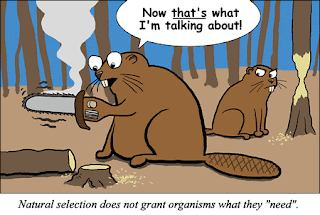
Today students created their own jeopardy review questions on the DNA structure and replication, as well as transcription and translation. We used the mini whiteboards for each pair to write their answers down. Next week we will begin learning about evolution. As we do this, remember this cartoon:
Your test has the following question types: multiple choice, fill in the blank, true/false, short answer and one essay.

Your test has the following question types: multiple choice, fill in the blank, true/false, short answer and one essay.
Wednesday, February 15, 2012
Transcription & Translation Worksheet
For homework, G period should finish the worksheet from class today. The codon chart is on page 303 in your book and it is also posted below.

C period: We reviewed in class today and G period we will review tomorrow for your test on Friday.
C period: We reviewed in class today and G period we will review tomorrow for your test on Friday.
Tuesday, February 14, 2012
Expanding on Transcription & Translation
Today we continued our work on Transcription & Translation.
G period homework: complete the worksheet (both sides). The colors you use do not matter, so long as you are consistent.
C period homework: complete the transcription and translation sheet from class today. HINT: rRNA is the RNA component of a ribosome.
G period homework: complete the worksheet (both sides). The colors you use do not matter, so long as you are consistent.
C period homework: complete the transcription and translation sheet from class today. HINT: rRNA is the RNA component of a ribosome.
Friday, February 10, 2012
Homework for the Weekend
Today in class you made some great posters to review the structure of DNA and how DNA replicates. Here is your homework for the weekend:
You will be learning about transcription and translation. You have a choice in how you learn this information.
You can:
* Read pages 300-306 in your book
* Play this game from Utah Genetics
* Watch this video from the DNA Learning Center (more advanced)
You should take notes because you will have a short quiz in class on Monday (or Tuesday for G period).
You will be learning about transcription and translation. You have a choice in how you learn this information.
You can:
* Read pages 300-306 in your book
* Play this game from Utah Genetics
* Watch this video from the DNA Learning Center (more advanced)
You should take notes because you will have a short quiz in class on Monday (or Tuesday for G period).
Tuesday, February 7, 2012
DNA Replication
Today we started DNA replication. We used this animation to help us learn the basics and it is what you need to complete the homework.
Watch the Mechanisms of DNA replication below. Without the sound can you identify which is the leading strand and which is the lagging strand?
Watch the Mechanisms of DNA replication below. Without the sound can you identify which is the leading strand and which is the lagging strand?
Monday, February 7, 2011
DNA Articles
Today we spent time reading and interpreting articles from Science Daily. Click on the titles of the articles to link directly to them.
Smoking Causes Genetic Damage Within Minutes After Inhaling
If Junk DNA is Useful, Why Is It Not Shared More Equally?
Jumping Genes Caught in the Act: New Evidence That the Genome Contains Many Mobile Elements
First View of DNA Damage Within The Entire Human Genome
Tomorrow you have a test on sections 12.1, 12.2, DNA replication, Transcription & Translation
Smoking Causes Genetic Damage Within Minutes After Inhaling
If Junk DNA is Useful, Why Is It Not Shared More Equally?
Jumping Genes Caught in the Act: New Evidence That the Genome Contains Many Mobile Elements
First View of DNA Damage Within The Entire Human Genome
Tomorrow you have a test on sections 12.1, 12.2, DNA replication, Transcription & Translation
Thursday, February 3, 2011
Transcription & Translation
Today we learned about transcription & translation. Watch the videos below to help you review what happens in these two processes. Click here for the link to complete your homework.
Transcription
Translation
Transcription
Translation
Tuesday, February 1, 2011
DNA Replication
Today we learned about DNA replication. Click the picture below to link to the animation you need to use to complete your homework. The worksheet has been emailed to you via your TASIS email.
Friday, January 28, 2011
Test & Starting Ch. 12
Today students had a test on Chapter 11: Genetics & Meiosis.
Homework: Read section 12.1 and take notes for a reading quiz. Yes, I realize the section is a bit longer than you usually read. That's OK. You do not need to know the details of each of the experiments described, rather, focus on the bigger picture. What did each of these experiments contribute to science? What was discovered?
You should definitely take notes on the components and structure of DNA.
Homework: Read section 12.1 and take notes for a reading quiz. Yes, I realize the section is a bit longer than you usually read. That's OK. You do not need to know the details of each of the experiments described, rather, focus on the bigger picture. What did each of these experiments contribute to science? What was discovered?
You should definitely take notes on the components and structure of DNA.
Friday, February 12, 2010
DNA replication, transcription and translation projects
DNA Replication Poster

 Yes, that IS marzipan DNA and RNA!
 And that, my friends, is a translation pie.
Gel Electrophoresis
On Wednesday and Thursday we did Gel Electrophoresis using food coloring to see how molecules of different sizes move through the gel. The first step was to load the gels.
 One all of the wells are loaded, an electrical current is run through the gel to move the molecules.

Voila! Results! Look closely and you can see that the black in the first well (on the bottom), has actually separated out into a purple and an orange. Blue is the largest molecule and therefore it moved the shortest distance. Gels were made with 2.5g agarose and 250mL 1x TAE buffer and run for ~ 20 minutes.
 One all of the wells are loaded, an electrical current is run through the gel to move the molecules.
Voila! Results! Look closely and you can see that the black in the first well (on the bottom), has actually separated out into a purple and an orange. Blue is the largest molecule and therefore it moved the shortest distance. Gels were made with 2.5g agarose and 250mL 1x TAE buffer and run for ~ 20 minutes.

Monday, February 8, 2010
Genetically Modified Foods
How do you think scientists create genetically modified organisms? Even if you have no idea, write something down, THINK CREATIVELY!
2. We are going to watch an animation on Recombinant DNA technology. The questions that follow relate to this animation.
a. What is a vector?
b. What is a plasmid?
c. What are restriction enzymes?
d. What are the “sticky ends” of the gene segments? Use a drawing in your answer.
e. What is a transgenic plant?
3. What do you think are some of the benefits of transgenic organisms (T.O) (list at least 4)
4. What do you think are some of the controversies surrounding T.O.’s (list at least 4)
5. Video Monsanto: How does this make you feel about GMOs/TOs? Write at least 4 sentences.
Video India: How does this make you feel about GMOs/TOs? Write at least 4 sentences.
7. Video: The Future of Food Intro. What are three things you learned from this video clip?
Homework: Find an article on genetically modified foods. This article must be from 2007 to the present. Complete the article summary sheet.
Places to look for articles include: http://news.nationalgeographic.com/news/
Samples of Student work
Below are samples of some DNA replication, transcription and translation projects I have received in the past.


Friday, February 5, 2010
DNA replication, transcription and translation project.
Your project is due Friday February 12th, in class. You will be presenting your projects. This counts as a test grade. Click on the images below to see the rubric, each group will also get a copy of it on Monday, in class.
NOTE: This rubric has changed! The original rubric posted left off points for properly citing your sources. This is now part of the rubric.

NOTE: This rubric has changed! The original rubric posted left off points for properly citing your sources. This is now part of the rubric.


Tuesday, February 2, 2010
DNA extraction
 Today students extracted DNA from strawberries. Yvo, Claudia, Mariam and Finn had spectacular results.
After the lab, we started to learn about DNA replication. Tonight for homework complete the DNA replication worksheet using the online animation.
Click the picture below to link to the animation.

Subscribe to:
Posts (Atom)