There is no homework due Monday. If you are unsure about the pH scale, click the picture below to link to an interactive pH scale. Use the brown arrows in the lower left of the animation to navigate. The interactive pH scale is on the third slide.
“Education, therefore, is a process of living and not a preparation for future living.” ~ John Dewey
Showing posts with label Chemistry. Show all posts
Friday, September 16, 2011
Properties of Water
Today students had a reading quiz on section 2.2 and we learned about the properties of water. In our seeds and salt experiment, we saw how plants take advantage of the cohesive and adhesive properties of water to take in water through their roots. Many of us experienced evaporative cooling in class over the past few days. If you go swimming in Lake Lugano or tubing at Lago Maggiore over the weekend, you'll be taking advantage of water's high specific heat (even though it has been cool at night, the lakes are still warm). So even without realizing it, you benefit from the unique properties of water everyday.
There is no homework due Monday. If you are unsure about the pH scale, click the picture below to link to an interactive pH scale. Use the brown arrows in the lower left of the animation to navigate. The interactive pH scale is on the third slide.
Wednesday, September 14, 2011
Chapter 2 - Radioactive Dating, Chemical Bonds and the Properties of Water
G Period: Today students collected data from the seeds & salt experiment. After collecting the data, students were given a chapter 2 pre-inventory and we started to learn about basic chemistry.
G Period Homework: Read pages 37-39 and take notes for a reading quiz. Any notes you take, you can use on the quiz.
C Period: Today continued to collect data from their seeds and salt experiment, after which students had a reading quiz on pages 37-39. We moved on to section 2-2, the properties of water.
C Period Homework: Read and take notes on section 2-2, you will have a reading quiz in your next class.
Here are two video clips to help you understand chemical bonding and radiocarbon dating.
Chemical Bonding:
Radio Carbon Dating:
G Period Homework: Read pages 37-39 and take notes for a reading quiz. Any notes you take, you can use on the quiz.
C Period: Today continued to collect data from their seeds and salt experiment, after which students had a reading quiz on pages 37-39. We moved on to section 2-2, the properties of water.
C Period Homework: Read and take notes on section 2-2, you will have a reading quiz in your next class.
Here are two video clips to help you understand chemical bonding and radiocarbon dating.
Chemical Bonding:
Radio Carbon Dating:
Tuesday, September 13, 2011
Starting Ch. 2
C period class summary:
Students collected data from the seeds & salt experiment. After collecting the data, students were given a chapter 2 pre-inventory and we started to learn about basic chemistry.
C period homework:
Read pages 37-39 and take notes for a reading quiz. Any notes you take, you can use on the quiz.
G period class summary:
After some rather serious debate about the best method for collecting data, students collected their second set of bean growth data. With the remaining class time students started the Interpreting Data packet.
G period homework:
Complete the Interpreting Data packet. Also complete the book tour.
Students collected data from the seeds & salt experiment. After collecting the data, students were given a chapter 2 pre-inventory and we started to learn about basic chemistry.
C period homework:
Read pages 37-39 and take notes for a reading quiz. Any notes you take, you can use on the quiz.
G period class summary:
After some rather serious debate about the best method for collecting data, students collected their second set of bean growth data. With the remaining class time students started the Interpreting Data packet.
G period homework:
Complete the Interpreting Data packet. Also complete the book tour.
Friday, May 6, 2011
Proteins
Today we focused on the third class of macromolecules: Proteins.
Brace yourself for this shocking discovery....proteins are formed when amino acids are joined together by peptide bonds and when water is removed! Are we noticing a trend yet....?
Proteins having many functions including as enzymes and transport molecules. We didn't spend a lot of time on enzymes because we learned about this in the fall. Click here to see a video of how enzymes work.
Proteins play in an important role in transport of molecules across a cell membrane. As you know, phospholipids have a hydrophylic head and hydrophobic tail. In order for the transport proteins to maintain their location in the bilayer they have to have polar and nonpolar components.
There is no homework for Monday other than to study for your test on Friday May 13th.
Brace yourself for this shocking discovery....proteins are formed when amino acids are joined together by peptide bonds and when water is removed! Are we noticing a trend yet....?
Proteins having many functions including as enzymes and transport molecules. We didn't spend a lot of time on enzymes because we learned about this in the fall. Click here to see a video of how enzymes work.
Proteins play in an important role in transport of molecules across a cell membrane. As you know, phospholipids have a hydrophylic head and hydrophobic tail. In order for the transport proteins to maintain their location in the bilayer they have to have polar and nonpolar components.
There is no homework for Monday other than to study for your test on Friday May 13th.
Wednesday, May 4, 2011
Lipids!
Today students completed a short guided notes sheet, before building models of various fatty acids.

Homework: Due Friday (courtesy of Mrs. Yust-Averett). Answer the questions below, you do not need to write the questions, just the number of the question.
1. What is the elemental composition of lipids?
2. How can you differentiate between carbohydrates and lipids when looking at a molecule or given a chemical formula?
3. What are the 4 main types of lipids (molecules)? (you will need to look this up).
4. What are the main functions of lipids?
5. What type of covalent bond (linkage) can be found between a glycerol molecule and fatty acid tails?
6. Are lipids polar or non-polar? How does this effect their interaction with water?
7. Explain the structure of triglycerides (look this up).
8. What is the main function of triglycerides (look this up).
9. Compare saturated and unsaturated fatty acids (number of hydrogen atoms, physical state at room temperature, healthy or unhealthy, single or double bonds between carbon atoms, ease broken down by body, sources found in nature, food examples) (look this up).

Homework: Due Friday (courtesy of Mrs. Yust-Averett). Answer the questions below, you do not need to write the questions, just the number of the question.
1. What is the elemental composition of lipids?
2. How can you differentiate between carbohydrates and lipids when looking at a molecule or given a chemical formula?
3. What are the 4 main types of lipids (molecules)? (you will need to look this up).
4. What are the main functions of lipids?
5. What type of covalent bond (linkage) can be found between a glycerol molecule and fatty acid tails?
6. Are lipids polar or non-polar? How does this effect their interaction with water?
7. Explain the structure of triglycerides (look this up).
8. What is the main function of triglycerides (look this up).
9. Compare saturated and unsaturated fatty acids (number of hydrogen atoms, physical state at room temperature, healthy or unhealthy, single or double bonds between carbon atoms, ease broken down by body, sources found in nature, food examples) (look this up).
Tuesday, May 3, 2011
Carbohydrate Structure
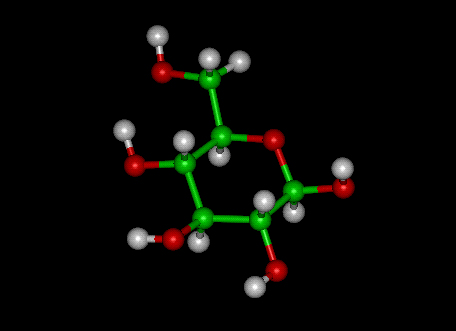
Today students built models of carbohydrates and learned how monosaccharides join together to form di and polysaccharides.

1. Which elements do carbohydrates contain, and in what ratio?
2. If a sugar compound has 11 oxygen atoms, how many hydrogen atoms does it contain?
3. Based on their molecular formulas, which of the following are NOT carbohydrates?
a. C3H803
b. C10H18O9
c. C18H32O16
d. C4H8O2
e. C16H32O2
f. C6H12O6
4. For each molecule below, determine if it is a monosaccharide, a disaccharide, or a polysaccharide. You will need to look these up on your own.
a. Fructose
b. Ribose
c. Cellulose
d. Glucose
e. Sucrose
f. Glycogen
5. Describe a biological function for each of the following carbohydrates
a. Cellulose
b. Ribose
c. Starch
d. Glycogen
e. Deoxyribose
f. Fructose
g. Sucrose
6. Draw the molecular structure of the following carbohydrates:
RIBOSE
GLUCOSE
7. Briefly describe the process of the condensation reaction (dehydration synthesis) for carbohydrates.
8. Briefly describe the process of the hydrolysis reaction for carbohydrates.

Carbohydrates Homework Questions
1. Which elements do carbohydrates contain, and in what ratio?
2. If a sugar compound has 11 oxygen atoms, how many hydrogen atoms does it contain?
3. Based on their molecular formulas, which of the following are NOT carbohydrates?
a. C3H803
b. C10H18O9
c. C18H32O16
d. C4H8O2
e. C16H32O2
f. C6H12O6
4. For each molecule below, determine if it is a monosaccharide, a disaccharide, or a polysaccharide. You will need to look these up on your own.
a. Fructose
b. Ribose
c. Cellulose
d. Glucose
e. Sucrose
f. Glycogen
5. Describe a biological function for each of the following carbohydrates
a. Cellulose
b. Ribose
c. Starch
d. Glycogen
e. Deoxyribose
f. Fructose
g. Sucrose
6. Draw the molecular structure of the following carbohydrates:
RIBOSE
GLUCOSE
7. Briefly describe the process of the condensation reaction (dehydration synthesis) for carbohydrates.
8. Briefly describe the process of the hydrolysis reaction for carbohydrates.
Thursday, September 16, 2010
The Nature of Matter (starting chapter 2)
NOTE: This post is for Thursday and Friday because on Friday we are running a Wednesday schedule.
Today students collected data from their pea experiments. Some of the peas have started to germinate! After collecting the data and talking about the feasibility of collecting data everyday, we moved on to start chapter 2: The Nature of Matter.
Students were given a guided notes sheet to help organize their notes. We watched a short video clip on carbon dating. Click here to see it.
Homework:
Watch the video clip below and use the information to complete the table in your notes packet that compares ionic and covalent bonding.
After watching the video, finish reading section 2-1 in your book to complete the questions on Van der Waals forces etc. You also need to finish the check-in questions for homework. You should use all of section 2-1 (pages 35-39) in your book to help you review.
This is due on Monday.
Today students collected data from their pea experiments. Some of the peas have started to germinate! After collecting the data and talking about the feasibility of collecting data everyday, we moved on to start chapter 2: The Nature of Matter.
Students were given a guided notes sheet to help organize their notes. We watched a short video clip on carbon dating. Click here to see it.
Homework:
Watch the video clip below and use the information to complete the table in your notes packet that compares ionic and covalent bonding.
After watching the video, finish reading section 2-1 in your book to complete the questions on Van der Waals forces etc. You also need to finish the check-in questions for homework. You should use all of section 2-1 (pages 35-39) in your book to help you review.
This is due on Monday.
Thursday, September 11, 2008
Organic Chemistry
Note: This post is for A block on 9.11.08 as well as D and C blocks on 9.12.08
By the end of the class students should be able to:
Homework: This homework is due at your next class meeting.
Read about the seven functional groups we talked about in class here.
For Example: You are responsible for knowing that the Hydryoxyl Group (OH)
Check out these links for help:
Understanding the names of organic compounds
Alkanes, Alkenes, Alkynes
Matching Organic Functional Groups
By the end of the class students should be able to:
•
Homework: This homework is due at your next class meeting.
Read about the seven functional groups we talked about in class here.
For Example: You are responsible for knowing that the Hydryoxyl Group (OH)
- are compounds containing -OH and are alcohols. Eg. ethanol, sugars, phenol
- -OH group is polar. Therefore such compounds dissolve in water (sugars)
Check out these links for help:
Understanding the names of organic compounds
Alkanes, Alkenes, Alkynes
Matching Organic Functional Groups
Tuesday, September 9, 2008
Overview of Chapter 1 and Chemistry Review
Today we spent 15 minutes answering questions from chapter one (mainly on the difference between prokaryotes and eukaryotes as well as the difference between food webs and chains).

Homework: (all blocks) If there were any questions that you are still having trouble with look at that section in the book. The numbers parentheses at the end of the question correspond to the section in the book.
C block: you do NOT need to wear closed toed shoes to lab tomorrow. All other labs you will need to wear closed toed shoes.
Students completed a chemistry reivew (see below)

- Does having a basic understanding of chemistry help when it comes to learning biology? Explain your answer using no more than 5 sentences.
- What six elements are most common in living matter? (2.2)
- List any three compounds in the human body. (2.3)
- Explain and give an example of an isotope. (2.4)
- How many covalent bonds does H, O, N, C and S make? (2.6)
- Draw the electron configuration for the following elements: Na & Cl. (2.6/2.7)
- Explain and give an example of an ionic bond. (2.7)
- Explain and give an example of a covalent bond. (2.8)
- What is chemically nonsensical about this structure? (2.8) H---C==C----H
- Water is kind of a big deal in biology. Tell me everything that you know about water that you consider relevant. (2.9-2.14)
11. Based on what you know about pH, make a prediction about the role that pH plays in living systems. (2.15-2.16)
12. The relationship between structure and function is a theme that is central in biology. Describe the relationship between structure and function using any molecule of your choice.
We discussed the importance of spring turnover in aquatic ecosystems and what happens when a thermocline occurs as well as what happens at the molecular level for acid reflux.Homework: (all blocks) If there were any questions that you are still having trouble with look at that section in the book. The numbers parentheses at the end of the question correspond to the section in the book.
C block: you do NOT need to wear closed toed shoes to lab tomorrow. All other labs you will need to wear closed toed shoes.
Thursday, September 13, 2007
Properties of Water
D Block:
Students had a quiz on Chapter 2. After completing the quiz we finished section 3.2 on the properties of water.
Homework: Complete the properties of water homework.
Confused on the what adhesion and cohesion are? Watch the video below.
Students had a quiz on Chapter 2. After completing the quiz we finished section 3.2 on the properties of water.
Homework: Complete the properties of water homework.
Confused on the what adhesion and cohesion are? Watch the video below.
Tuesday, September 11, 2007
Basic Chemistry Review
Today we reviewed Chapter 2, which is on basic chemistry.
Homework: B Block complete the "self quiz" at the end of chapter 2 in preparation for a chapter 2 quiz tomorrow (Wednesday). In addition write at least 2 paragraphs to answer the questions in the "Scientific Inquiry" box on page 46 (of the 7th ed.).
Subscribe to:
Posts (Atom)

