As we continue to learn about microevolution, we watched PBS's Evolution Arms Race. Students answered guided questions and wrote their own questions which we used for a discussion.
When we return from Academic Travel we will be shifting our focus from microevolution to macroevolution.
Friday, February 24, 2012

Tuesday, February 21, 2012
How populations evolve
Today we brainstormed ideas about some of the evidence that validates the evolutionary view of life. For part 1 of your homework: look up information on the four key terms on the first page of the packet. What does a person study if they are in the field of comparative embryology? What is an example of a homology? What do homologies tell us about the relationship between species?
Darwin proposed natural selection as a mechanism of evolution, as it turns out there are four parts of evolution. However, since your book starts with Natural Selection, that's where we will begin.
To see natural selection in action we read a case study about microevolution in a specie of crickets in Hawaii.
Attack of the Mutant Crickets!!!
"Attack of the flesh-eating parasitoid maggots!! Mutant mute crickets run rampant in tropical paradise!! The headlines may sound like a trailer for a cheap horror flick — but in fact, these sensationalist sound bites accurately describe the situation on the Hawaiian island of Kauai. The "flesh-eating parasitoid maggots" are the offspring of the fly, Ormia ochracea, which invaded Hawaii from North America, and the mutant crickets are the flies' would-be victims. The flies follow the chirps of a calling cricket and then deposit a smattering of wriggling maggots onto the cricket's back. The maggots burrow into the cricket, and emerge, much fatter, a week later — killing the cricket in the process. But this fall, biologists Marlene Zuk, John Rotenberry, and Robin Tinghitella announced a breakdown in business-as-usual in this gruesome interaction: in just a few years, the crickets of Kauai have evolved strategy to avoid becoming a maggot's lunch — but the strategy comes at a cost... " Want to read more or see the article with color photos? Click here.
If you did not finish your summary of the case study in class you need to do that for homework as well. Not sure where to start for you summary, think of how this case study is an example of natural selection.
Lastly, define the terms/concepts on page six of the packet.
Lastly, define the terms/concepts on page six of the packet.
Thursday, February 16, 2012
Test Review
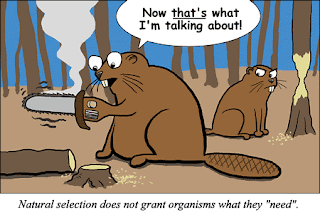
Today students created their own jeopardy review questions on the DNA structure and replication, as well as transcription and translation. We used the mini whiteboards for each pair to write their answers down. Next week we will begin learning about evolution. As we do this, remember this cartoon:
Your test has the following question types: multiple choice, fill in the blank, true/false, short answer and one essay.

Your test has the following question types: multiple choice, fill in the blank, true/false, short answer and one essay.
Wednesday, February 15, 2012
Transcription & Translation Worksheet
For homework, G period should finish the worksheet from class today. The codon chart is on page 303 in your book and it is also posted below.

C period: We reviewed in class today and G period we will review tomorrow for your test on Friday.
C period: We reviewed in class today and G period we will review tomorrow for your test on Friday.
Tuesday, February 14, 2012
Expanding on Transcription & Translation
Today we continued our work on Transcription & Translation.
G period homework: complete the worksheet (both sides). The colors you use do not matter, so long as you are consistent.
C period homework: complete the transcription and translation sheet from class today. HINT: rRNA is the RNA component of a ribosome.
G period homework: complete the worksheet (both sides). The colors you use do not matter, so long as you are consistent.
C period homework: complete the transcription and translation sheet from class today. HINT: rRNA is the RNA component of a ribosome.
Monday, February 13, 2012
Transcription & Translation
Today students had a homework quiz on the basics of transcription & translation. After the quiz we went into more detail about how the process works.
Homework: Complete the worksheet (front and back). Be sure to take care in using complementary base pairs for the DNA strand. The colors you use don't matter, so long as you are consistent.
Reminder: You will have a test on DNA structure, replication and transcription / translation on Friday.
Homework: Complete the worksheet (front and back). Be sure to take care in using complementary base pairs for the DNA strand. The colors you use don't matter, so long as you are consistent.
Reminder: You will have a test on DNA structure, replication and transcription / translation on Friday.
Friday, February 10, 2012
Homework for the Weekend
Today in class you made some great posters to review the structure of DNA and how DNA replicates. Here is your homework for the weekend:
You will be learning about transcription and translation. You have a choice in how you learn this information.
You can:
* Read pages 300-306 in your book
* Play this game from Utah Genetics
* Watch this video from the DNA Learning Center (more advanced)
You should take notes because you will have a short quiz in class on Monday (or Tuesday for G period).
Tuesday, February 7, 2012
DNA Replication
Today we started DNA replication. We used this animation to help us learn the basics and it is what you need to complete the homework.
Watch the Mechanisms of DNA replication below. Without the sound can you identify which is the leading strand and which is the lagging strand?
Watch the Mechanisms of DNA replication below. Without the sound can you identify which is the leading strand and which is the lagging strand?
Gel Electrophoresis Pictures
Today G period practiced using gel electrophoresis and got great results! After practicing micro-pipetting and learning how to read the 2-20uL and 20-200uL pipettes, students were ready to decide what color (or mixture) of colors to load in their gels (the ideal volume for the wells is 8uL). Check out the pictures of the set up below.
 |
| Materials for the lab (and our class mascot). |
 |
| A gel loaded and ready to be run. |
 |
| The new BioRad Power Packs are amazing! We ran two gels at a time for 18 minutes, at 300V and had great results. |
 |
| Even after only two minutes, you can start to see the green dye in lane 1 has separated out into blue and yellow dye. |
 |
| A finished gel after 18 minutes at 300V. |
 |
| Notice how the black food coloring is actually made out of orange and purple dye. Can you determine which molecules of dye are the largest and which are the smallest? |
 |
| Marcela records her results. |
 |
| Antonia and Milly record their results. |
Monday, February 6, 2012
Gel Electrophoresis
Today students learned how to use micropipettes as well as how to run gel electrophoresis. Tomorrow's post (from G period) will have pictures and a more in depth summary of the lab.
There is no homework tonight :)
There is no homework tonight :)
Wednesday, February 1, 2012
Strawberry DNA Extraction
Today we extracted DNA from strawberries and had great results!

C period Homework: Complete the gel electrophoresis virtual lab. Click here to link to the virtual lab. Take notes on gel electrophoresis. You will have a short reading quiz on Friday before we actually do gel electrophoresis.
G period: No homework (unless you want to do the virtual lab, so you don't have homework on Thursday night).
Tuesday, January 31, 2012
Classical Genetics & Meiosis Test

Saturday, January 28, 2012
Test Review
On Friday students worked on a review packet for their test on Genetics & Meiosis on Tuesday January 31st.
On Monday we will be starting our next unit on DNA.
On Monday we will be starting our next unit on DNA.
Thursday, January 26, 2012
Mutations and Baby Dragons for G period
Today G period learned about various types of mutations as well as created their baby dragons. Dragons and the questions at the back of the packet are due tomorrow in class. Please answer the questions on a separate sheet of paper and each person should answer the questions as well as draw his/her own dragon.
Tomorrow we will recap what we have learned about genetics.
Tomorrow we will recap what we have learned about genetics.
Wednesday, January 25, 2012
Nondisjunction Disorders
Today students did a jigsaw activity to learn about six different types of nondisjunction disorders:
* Down Syndrome
* Edward's Syndrome
* Patau Syndrome
* Klinefelter Syndrome
* Turner Syndrome
* XYY Syndrome
For homework, complete the vocabulary self evaluation on page 12 of your packet.
Below is a graph for the incidence of Down Syndrome relative to the age of the mother during pregnancy.
 Read more about Down Syndrome testing in this New York Times article.
* Down Syndrome
* Edward's Syndrome
* Patau Syndrome
* Klinefelter Syndrome
* Turner Syndrome
* XYY Syndrome
 |
| Karyotype of a female with Trisomy 21 from Nature.ca |
Below is a graph for the incidence of Down Syndrome relative to the age of the mother during pregnancy.
Tuesday, January 24, 2012
Baby Dragons!
C period made baby dragons today in class. G period will do this activity on Thursday.
C period - answer the questions on the last page of the packet (use a separate sheet of paper to write your answers). You also need to draw your dragon. Each person should draw his/her own dragon.
G period - read about TSD in the post below and answer the questions.
C period - answer the questions on the last page of the packet (use a separate sheet of paper to write your answers). You also need to draw your dragon. Each person should draw his/her own dragon.
G period - read about TSD in the post below and answer the questions.
Monday, January 23, 2012
Gene Linkage, Sex Chromosomes and Mutations
Today (or tomorrow for G period) we worked on pages 7-9 of the packet. However, not all species have sex chromosomes. We talked about sex determination in wasps and tonight for homework, you will learn about the effects that temperature can play on sex determination.
1. Read this article from Davidson.edu on temperature dependent sex determination
2. Answer the following questions:
a. What is the difference between GSD and ESD?
b. What is TSD?
c. Do humans exhibit GSD or ESD?
d. Give two examples of organisms which lack sex chromosomes.
e. What are the two patterns of TSD?
f. Global temperatures have been rising. What effects could this have on crocodilians and some species of turtles?
 |
| Photo Credit Here |
Friday, January 20, 2012
Meoisis I
Today we started to learn about Meiosis.
Homework:
Draw the stages of Meiosis II. Make sure to label the centrioles in at least one picture. Draw these pictures at the top of page 7 in your packet.
Homework:
Draw the stages of Meiosis II. Make sure to label the centrioles in at least one picture. Draw these pictures at the top of page 7 in your packet.
 |
| http://images.tutorvista.com/content/cell-reproduction/meiosisii-stage.jpeg |
Thursday, January 19, 2012
Homework for Friday
G period - complete the vocab for pages 1 - 4.
Both classes:
Read and take notes on section 11-4 in your book (starting on page 275) for a reading quiz. Focus on the key concepts and vocabulary. To help focus your notes, consider answering the section assessment questions on page 278. NOTE: Drawings of the stages of meiosis are NOT required for the reading quiz. We will be doing an activity in class on Friday where we work with the stages of meiosis and spend time drawing them.
Still struggling? Sing along to the Meiosis Square Dance Video!
Wednesday, January 18, 2012
Variations on Mendel
G period:
Today we completed page 3 in the packet and learned about test crosses and pedigrees. Spoiler Alert! If you haven't seen the last Harry Potter movie, this pedigree will ruin the end for you.

It's not very efficient to draw complete portraits for a pedigree. Instead scientists uses symbols (circles or squares) and shade them in to designate if an individual is affected, unaffected or a carrier.
G Period Homework - Read the post below for information on amniocentesis and chorionic villus sampling.
C period:
Today we completed page 5 in the packet and learned about variations on Mendel's principles: incomplete dominance, codominance, pleiotropy and polygenic inheritance.
C period homework: Read section 11-4 (starting on page 275) and take notes for a reading quiz. Keep the main points of the reading in mind. You do not need to draw the stages of meiosis, we will do an activity for this in class.
Subscribe to:
Posts (Atom)