Wondering how your project is going to be graded? Well here it is:
Content 62 points: 2 points for each word/concept (one point for each image and one point for each explanation)
Bibliography 10 points: all images and text are cited in the proper MLA format
Creativity & Formatting 14 points: the use of color and text style enhances the presentation.
Spelling & Grammar 14 points: there are no spelling nor grammatical errors.
Sunday, April 27, 2008

Friday, April 25, 2008
Chapter 53 project updates
Some changes to the content for the project have been made. Please see the changes below. I will be on duty in Lindsey this evening and around on Sunday if you need help. Please email me to set up a time.
Here are the terms that you need to include AND have collected evidence (pictures or drawings) from the sites we visited:
species richness
relative abundance
predation
secondary succession
interspecific interactions
parasitism
herbivory
community
biogeography
cryptic coloration
ecological niche
ectoparasite
prey
realized niche
exotic/introduced species
disturbances
The terms below you need to include along with images and an explanation, however you can find these in your book or on the web.
individualistic hypothesis
interactive hypothesis
coevolution
aposematic coloration
Batesian mimicry
Mullerian mimicry
endoparasites
interspecific competition
interference competition
exploitative competition
fundamental niche
symbiosis
commensalism
mutualism
primary succession
You no longer need to include the following terms:
parasitoidism
predator
parasite
host
competitive exclusion principal
stability
recruitment
dynamic equalibrium hypothesis
You should get satellite and or terrain images from google. You do not need a separate slide for each term.
Here are the terms that you need to include AND have collected evidence (pictures or drawings) from the sites we visited:
species richness
relative abundance
predation
secondary succession
interspecific interactions
parasitism
herbivory
community
biogeography
cryptic coloration
ecological niche
ectoparasite
prey
realized niche
exotic/introduced species
disturbances
The terms below you need to include along with images and an explanation, however you can find these in your book or on the web.
individualistic hypothesis
interactive hypothesis
coevolution
aposematic coloration
Batesian mimicry
Mullerian mimicry
endoparasites
interspecific competition
interference competition
exploitative competition
fundamental niche
symbiosis
commensalism
mutualism
primary succession
You no longer need to include the following terms:
parasitoidism
predator
parasite
host
competitive exclusion principal
stability
recruitment
dynamic equalibrium hypothesis
You should get satellite and or terrain images from google. You do not need a separate slide for each term.
Thursday, April 24, 2008
Last Day Outside
Today was the last for collecting organisms and Nicoya spotted a great newt as we were leaving. Tomorrow students will have another quiz on the terms and concepts for chapter 53 and we'll talk more about the expectations for the project due on Monday.
Wednesday, April 23, 2008

And the results are in...
The quiz that you took on Monday told me that we have some serious work to do in order for you to be prepared for your projects due on Monday April 28th. To recap your projects you need examples of local flora and fauna that fit each of the terms from chapter 53. I will be posting a few slides sample sides later this evening.
Yesterday we had a lot of success catching various organisms (backswimmers, a large newt, a salamander, a tadpole and small fish).
Today we will be going to a new site where yesterday I saw several large frogs and lots of evidence of bacteria.
Yesterday we had a lot of success catching various organisms (backswimmers, a large newt, a salamander, a tadpole and small fish).
Today we will be going to a new site where yesterday I saw several large frogs and lots of evidence of bacteria.
Thursday, April 17, 2008
So what have we been doing this week?
Well, the big news is that you have an additional week to complete your projects, and as such those projects had better FANTASTIC.
Yesterday Nate caught a fish in the Pemi on his first try with the dip nets, we also caught numerous other aquatic insects and learned what not to wear when we go out in the field.
Below are some pictures that Mike took today.
Yesterday Nate caught a fish in the Pemi on his first try with the dip nets, we also caught numerous other aquatic insects and learned what not to wear when we go out in the field.
Below are some pictures that Mike took today.
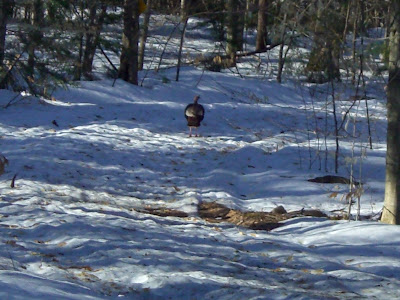
As we pulled up to Burleigh we saw five wild turkeys, some of them were even engaged in displays by ruffling their feathers.

Moose scat (an example of evidence of a herbivore). 
Moose Tracks and these were fairly far apart, meaning the moose could be quite large.
Spring is Here! This Red Maple (Acer rubrum) bud burst.

Moose Tracks and these were fairly far apart, meaning the moose could be quite large.

Spring is Here! This Red Maple (Acer rubrum) bud burst.

Tuesday, April 15, 2008
A walk in the woods
Today B block went up to Burleigh Mountain to look for examples of communities, species richness, introduced species and many of the other things for their community ecology project.
Click on the picture below to be taken to the "What Tree is That?" a free website from ArborDay.org

Click on the picture below to be taken to the "What Tree is That?" a free website from ArborDay.org
Monday, April 14, 2008
Chapter 53 Project:
Chapter 53 Assignment
species richness
relative abundance
species diversity
predation
individualistic hypothesis*
interactive hypothesis*
secondary succession
interspecific interactions
coevolution*
parasitism
parasitoidism
herbivory
community
biogeography
cryptic coloration*
aposematic coloration*
mimicry
Batesian mimicry*
Mullerian mimicry*
parasite
hosts
endoparasites*
ectoparasites
interspecific competition
interference competition
exploitative competition
competitive exclusion principle*
ecological niche
fundamental niche
prey
realized niche
resource partitioning
character displacement*
commensalism
mutualism
keystone species
exotic species
stability
disturbances
ecological succession
primary succession
recruitment
dynamic equilibrium hypothesis
intermediate disturbance hypothesis
Friday, April 11, 2008
Cemetery Data Analysis
Today we went to the ARC and many students used excel for the first time (and realized what a nightmare it can be). Rather than use our data we will be using sample data which will be much easier to work with. You should use the paper I gave you in class for the data.
Please make graphs in excel comparing the following populations, all graphs will have age class on the X axis and survivorship on the Y axis. When you select the type of graph, make sure you choose scatter and then you can choose to have the points connected by lines. If you select line graph, it will not work!
 Graph 1: Post-1900 females & Post 1900 males (this most closely resembles our cemetery)
Graph 2: Post-1900 females & pre 1820 females
Graph 3: Post 1900 males & pre 1820 males
Graph 4: The summary of both sexes comparing pre-1820 & post 1900.
In addition you will need to analyze this data and write in terms of any patterns or trends that you see. What type of surviorship curve (I,II or III) does each time period most closely resemble etc...
You will be graded on the following:
1. Whether or not the graphs are correct
2. Having a title and labels for each graph
3. How detailed, insightful and accurate your analysis of the graphs is.
4. There should be two graphs per page and your analysis should be no more than one page.
If you have lost the data I gave you in class you can see me tonight when I am on duty in Moore.
Please make graphs in excel comparing the following populations, all graphs will have age class on the X axis and survivorship on the Y axis. When you select the type of graph, make sure you choose scatter and then you can choose to have the points connected by lines. If you select line graph, it will not work!
 Graph 1: Post-1900 females & Post 1900 males (this most closely resembles our cemetery)
Graph 2: Post-1900 females & pre 1820 females
Graph 3: Post 1900 males & pre 1820 males
Graph 4: The summary of both sexes comparing pre-1820 & post 1900.
In addition you will need to analyze this data and write in terms of any patterns or trends that you see. What type of surviorship curve (I,II or III) does each time period most closely resemble etc...
You will be graded on the following:
1. Whether or not the graphs are correct
2. Having a title and labels for each graph
3. How detailed, insightful and accurate your analysis of the graphs is.
4. There should be two graphs per page and your analysis should be no more than one page.
If you have lost the data I gave you in class you can see me tonight when I am on duty in Moore.
Tuesday, April 8, 2008
Dall Mountain Sheep
Today students learned how to interpret and graph a life table as well as make inferences about a population in a 15 year study. Learning about the Dall Sheep population was the first part of the lab on population ecology, in the second part of the lab students will gather data from a local cemetery to compare life expectancy in modern and historical populations.
The Dall Sheep we learned about in class today were studied on Mt. McKinely (also known as Denali). This summer while hiking in the Healy Range (across from Denali) we ran into several groups of Dall Sheep where we had set up camp. Click on the pictures to below to make them larger and you will be able to get a better look at the sheep.

Katie is in the lower left corner making dinner while the sheep had finally moved on from where we wanted to set up camp. A second group of sheep easily moved along higher on the ridge.
The Dall Sheep we learned about in class today were studied on Mt. McKinely (also known as Denali). This summer while hiking in the Healy Range (across from Denali) we ran into several groups of Dall Sheep where we had set up camp. Click on the pictures to below to make them larger and you will be able to get a better look at the sheep.

Katie is in the lower left corner making dinner while the sheep had finally moved on from where we wanted to set up camp.
 A second group of sheep easily moved along higher on the ridge.
Monday, April 7, 2008
Population Growth
How many people are in the United States? How many people are in the world? Today we started to think about how populations are distributed, what factors limit population growth and various types of survivorship curves.
 At the start of class we checked out the U.S. and World Population Clock. The population numbers were written on the board while students worked independently on a summary packet for Chapter 52. At the end of class students predicted how the numbers changed, needless to say there was some surprise. Try it for yourself while you're watching your favorite TV show. Check the clock at the beginning of the hour and then at the end. While you are watching TV so many things are happening in the world that you aren't aware of. Pretty mind blowing.
Homework for both classes:
1. Finish the packet.
2. Find an article that talks about world population growth, the population policy of a country of your choice or something along those lines. Write a summary of your article and your reaction to it.
 At the start of class we checked out the U.S. and World Population Clock. The population numbers were written on the board while students worked independently on a summary packet for Chapter 52. At the end of class students predicted how the numbers changed, needless to say there was some surprise. Try it for yourself while you're watching your favorite TV show. Check the clock at the beginning of the hour and then at the end. While you are watching TV so many things are happening in the world that you aren't aware of. Pretty mind blowing.
Homework for both classes:
1. Finish the packet.
2. Find an article that talks about world population growth, the population policy of a country of your choice or something along those lines. Write a summary of your article and your reaction to it.
Friday, April 4, 2008
Test on the Biosphere & Climate Change
Today both classes had a test on the biosphere and climate change.
Wednesday, April 2, 2008
In Hot Water
Today B block watched the video "In Hot Water" on the impacts of sea water rise and how that impacts not only plants and animals, but humans too.

In addition, students created acted out advertisements for products that can help reduce CO2 levels (like light bulbs, recycling, solar panels etc...)
Reminder: You will have a test on Friday, so study! I am on duty on Thursday night, if you need help.

In addition, students created acted out advertisements for products that can help reduce CO2 levels (like light bulbs, recycling, solar panels etc...)
Reminder: You will have a test on Friday, so study! I am on duty on Thursday night, if you need help.
Tuesday, April 1, 2008
Climate Change Part II
Today we continued our discussion on climate change and its consequences. On Friday students will have a test on climate change, basic weather patterns and an introduction to the biosphere.
Check out the Goddard Flight and Space Center for amazing satellite images and videos of ice melting, hurricanes, and more.
Click on the picture to see the video we watched in class today of the thermal satellite shots of Katrina. Look closely and you'll see the areas of cool water the hurricane left in its wake (note: this video may take a while to load).

Check out the Goddard Flight and Space Center for amazing satellite images and videos of ice melting, hurricanes, and more.
Click on the picture to see the video we watched in class today of the thermal satellite shots of Katrina. Look closely and you'll see the areas of cool water the hurricane left in its wake (note: this video may take a while to load).
Friday, March 28, 2008
climate change homework
B Block:
We talked about the scientific basis for climate change as well as reviewing climate patterns.
This homework is due Wednesday for both classes.
Part 1: Watch the NASA video clip "Taking the Earth's Temperature."
(This clip can be slow to load, be patient!)
Part 2: Read the article "2007 Was Tied as Earth's Second-Warmest Year" from NASA GISS Research News.
Part 3: Find an article from the popular news media (USA Today, Boston Globe, etc..) that discusses an increase in global temperature. Write a paragraph comparing this article with the one from NASA's website. You may want to compare the scientific methods (if any) that are discussed, any contradictions etc...
We talked about the scientific basis for climate change as well as reviewing climate patterns.
This homework is due Wednesday for both classes.
Part 1: Watch the NASA video clip "Taking the Earth's Temperature."
(This clip can be slow to load, be patient!)
Part 2: Read the article "2007 Was Tied as Earth's Second-Warmest Year" from NASA GISS Research News.
Part 3: Find an article from the popular news media (USA Today, Boston Globe, etc..) that discusses an increase in global temperature. Write a paragraph comparing this article with the one from NASA's website. You may want to compare the scientific methods (if any) that are discussed, any contradictions etc...
Climate Patterns & Ocean Currents
D block took notes on Aquatic Biomes (see post below).
B Block presented their handouts on aquatic biomes and moved ahead with climate and ocean currents.

What is climate? Is it the same as weather? No! Climate is what you expect and weather is what you get. We watched and discussed video clips on what causes the gulf stream and ocean temperatures and climate pattens.
B Block presented their handouts on aquatic biomes and moved ahead with climate and ocean currents.

What is climate? Is it the same as weather? No! Climate is what you expect and weather is what you get. We watched and discussed video clips on what causes the gulf stream and ocean temperatures and climate pattens.
Homework for both B and D block classes DUE MONDAY.
See your email for an analytical question on climate and currents. If you need help, I am on duty on Sunday night in Moore House.
See your email for an analytical question on climate and currents. If you need help, I am on duty on Sunday night in Moore House.
Wednesday, March 26, 2008
Aquatic Biomes
"I never knew there were so many zones in the ocean...."
B Block:
Today B block had a reading quiz on sections 50.1 and 50.2 as well as took notes on aquatic biomes and stratification.
D block:
Completed the ecosystem brainstorm (see post below). Homework: read and take notes on sections 50.1 and 50.2 for the reading notes quiz on Friday.
Homework for both classes:
•
•For one of the biomes you selected on pages 1094-1097:
•1. Create a handout for your classmates on this biome.
•2. Include at least 2 images (this can be hand drawn or from the web) as well as info from each of the sections in blue (physical environment, chemical…)
•3. You will be giving a brief oral summary to the class on Friday as well as a copy of the handout. Come to class with copies ALREADY made.
Tomorrow I am going to the NSTA Annual Convention in Boston, so hopefully I'll come back with some good stuff.
Tomorrow I am going to the NSTA Annual Convention in Boston, so hopefully I'll come back with some good stuff.
Tuesday, March 25, 2008
Welcome Back
This spring we are going to be focusing on ecosystems and the impact humans have on their environment. Today we started off with a brainstorm on what comes to mind when we hear the words "ecology," "sustainability" and "human impact."
Homework: Read sections 50.1 and 50.2, take notes and be prepared for a reading quiz next period.
Homework: Read sections 50.1 and 50.2, take notes and be prepared for a reading quiz next period.
Monday, March 3, 2008
Study Up!
Finals are this week which means break is next week. Horray! Rather than attempt to have a review session that meets everyone's needs, please email me if you would like to find a time to meet. My schedule is pretty open this week. Good Luck!
Subscribe to:
Posts (Atom)