Today you worked on connecting organelles and their functions, as well as identifying if the metabolic pathways were catabolic or anabolic. Below is the concept map you received in class.
Tomorrow D period will wrap up organelles and move on to the cell membrane, osmosis and diffusion. C period you will learn about osmosis and diffusion.
Monday, October 1, 2012

Thursday, September 27, 2012
Using Excel to Process the B-gal Lab Data
In an attempt to help everyone work at his/her own pace with Excel, below are two video tutorials on how to use Excel to process the data from the Beta-gal lab. You have all been emailed the class data to work with.
Below are your post lab questions. These are due Monday for C period and Tuesday for D period.
 |
| Click on the video button to play the screencast for how to calculate enzyme activity. |
 |
| Click on the video button to play the screencast for how to calculate variance, create a scatter plot and insert custom error bars. |
Wednesday, September 26, 2012
Winning Lab!
Congratulations to C period's lab winner: Victoria and Celeste, as well as D period's lab winners: Coco and Aiko. Major changes have been made to our schedule over the next few weeks, so please refer to the google doc, so you can appropriately mangage your time.
Please bring your computer to our next class and if you haven't yet emailed me your data, please so so!
Please bring your computer to our next class and if you haven't yet emailed me your data, please so so!
Saturday, September 22, 2012
Cells!
Today (or yesterday) you had a quiz on enzymes, ATP and metabolism. After the quiz we review the prelab (below). With the remaining time in class we started talking about cells. We created our own neural pathway with our hands and saw just how many cell types were used. We also started to watch the crash course video below: Cell City.
Your homework over the weekend is to do the prelab.
Your homework over the weekend is to do the prelab.
Friday, September 21, 2012
Beta Gal Enzyme Pre-Lab
This weekend you will need to read the Beta-Gal Enzyme prelab, which you can find here, you were also given a copy in class. Answer the prelab questions and make the data table BEFORE coming to lab. To help you to better visualize the lab set up, take a look at the picture below:

a) spectrophotometer. Not sure how one of these works? Watch this one minute video.
b) this cup contains you working enzyme, must be kept on ice.
c) stop solution. You will use this to stop the progress of the reaction
d) test tubes and test tube rack. Make sure to label all of the tubes using tape and a marker
e) disposable transfer pipettes
f) 5mL and 10mL pipettes. Fill with 10 mL and use to distribute 1.5 of working enzyme every 15 seconds.
g) cuvettes for the spectrophotemeter. MAKE SURE TO ONLY TOUCH THE SIDES WITH THE RIDGES. Wipe only using a Kim-Wipe (lint free cloth) not a paper towel.
Recall the animation that we did in class to manipulate how things like a change in temperature and changing the enzyme substrate concentration impacted enzyme activity. You can view that animation here.
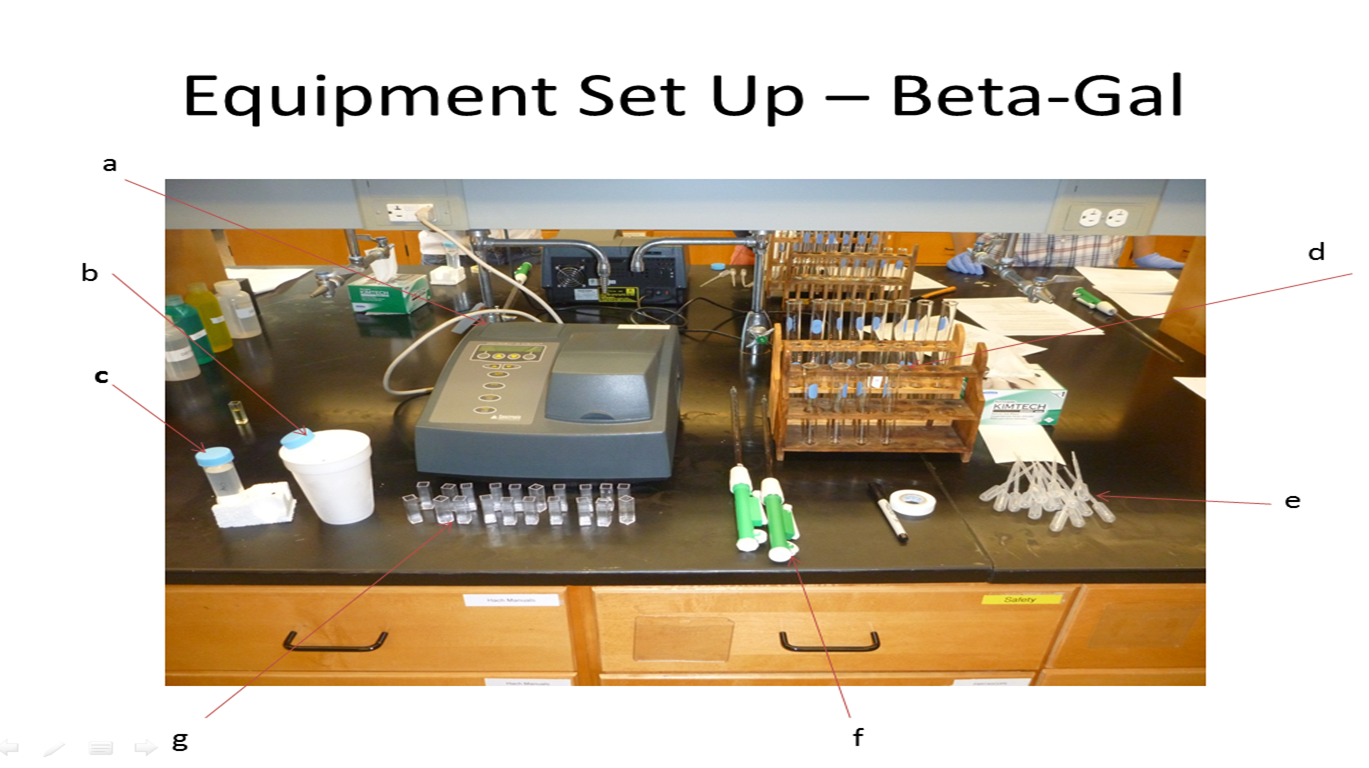
(click the picture to make it larger)
a) spectrophotometer. Not sure how one of these works? Watch this one minute video.
b) this cup contains you working enzyme, must be kept on ice.
c) stop solution. You will use this to stop the progress of the reaction
d) test tubes and test tube rack. Make sure to label all of the tubes using tape and a marker
e) disposable transfer pipettes
f) 5mL and 10mL pipettes. Fill with 10 mL and use to distribute 1.5 of working enzyme every 15 seconds.
g) cuvettes for the spectrophotemeter. MAKE SURE TO ONLY TOUCH THE SIDES WITH THE RIDGES. Wipe only using a Kim-Wipe (lint free cloth) not a paper towel.
Recall the animation that we did in class to manipulate how things like a change in temperature and changing the enzyme substrate concentration impacted enzyme activity. You can view that animation here.
Wednesday, September 19, 2012
Enzyme Concept Map
Today in class you created a concept map for enzymes. Below is a sample map that I created.
Homework: Read Module 14 for your next class. Since you have the quiz on ATP, Metabolism and Enzymes, you only need to read pages 70 and 73.
Homework: Read Module 14 for your next class. Since you have the quiz on ATP, Metabolism and Enzymes, you only need to read pages 70 and 73.
Tuesday, September 18, 2012
Enzymes
Here's what we know so far about enzymes:
Enzymes are a biological catalyst
They are proteins (which are made out of amino acids)
Enzymes lower the activation energy of a chemical reaction
Enzymes have optimum ranges of temperature and pH where they work best
Bind to substrates at specific active sites
Extremes for pH and/or temperature can denature enzymes (meaning the shape changes and it can no longer bind to the substrate)
Might not function properly if the DNA which encodes the enzyme is damaged.
Involved with both anabolic and catabolic reactions:
examples: anabolic enzyme = ATP synthase
catabolic enzyme = lactase
Many enzymes end in "ase."
Enzymes are not used up in chemical reactions.
Below are links to the enzyme animations we used in class
Basic enzyme function
ATP Synthase (movie)
Manipulating factors that effect enzyme productive (temp, pH)
Homework: C period - Read Module 12 for class tomorrow
D period - complete termite lab, submit via EMAIL.
Enzymes are a biological catalyst
They are proteins (which are made out of amino acids)
Enzymes lower the activation energy of a chemical reaction
Enzymes have optimum ranges of temperature and pH where they work best
Bind to substrates at specific active sites
Extremes for pH and/or temperature can denature enzymes (meaning the shape changes and it can no longer bind to the substrate)
Might not function properly if the DNA which encodes the enzyme is damaged.
Involved with both anabolic and catabolic reactions:
examples: anabolic enzyme = ATP synthase
catabolic enzyme = lactase
Many enzymes end in "ase."
Enzymes are not used up in chemical reactions.
Below are links to the enzyme animations we used in class
Basic enzyme function
ATP Synthase (movie)
Manipulating factors that effect enzyme productive (temp, pH)
Homework: C period - Read Module 12 for class tomorrow
D period - complete termite lab, submit via EMAIL.
Monday, September 17, 2012
Wrapping up ATP and Starting Enzymes
Today both classes tied together ATP and metabolism, using a lab activity created by Mr. Hansen. In this activity you needed to actually perform dehydration synthesis and identify ATP formation as an anabolic process.
Tonight you attend a screening of Journey of the Universe. I look forward to hearing your thoughts about the video tomorrow.
Tomorrow C period will start to learn about enzymes, while D period takes a closer look at primary literature on ATP and mitochondria.
Tonight you attend a screening of Journey of the Universe. I look forward to hearing your thoughts about the video tomorrow.
Tomorrow C period will start to learn about enzymes, while D period takes a closer look at primary literature on ATP and mitochondria.
Friday, September 14, 2012
Videos on cellular work and ATP hydrolysis
Today we took some time to clarify misconceptions about energy and ATP. Below are the videos we used to help improve our understanding.
All of this is inside your cell! The Kinesin motor protein starts at 1:16.
How the kinesin motor protein works
ATP Hydrolysis (up to 3:30 - we haven't discussed cellular respiration yet).
We didn't have time to watch this video on misconceptions about heat and temperature, but it is pretty nifty.
All of this is inside your cell! The Kinesin motor protein starts at 1:16.
How the kinesin motor protein works
ATP Hydrolysis (up to 3:30 - we haven't discussed cellular respiration yet).
We didn't have time to watch this video on misconceptions about heat and temperature, but it is pretty nifty.
Wednesday, September 12, 2012
Test Today
Today students had a test on Modules 1, 2 and 4.
C period: we will not meet again until Monday. Please read Module 24 for Monday. There is no lab on Monday, so you do not need to wear closed toed shoes, however, we will be working for the entire period.
Reminder: Your termite lab write up is due by 10:45am on Monday though Blackboard.
D period: Please read Module 24 for class on Friday.
Reminder: Your termite lab write up is due by 10:45am on Tuesday though Blackboard.
C period: we will not meet again until Monday. Please read Module 24 for Monday. There is no lab on Monday, so you do not need to wear closed toed shoes, however, we will be working for the entire period.
Reminder: Your termite lab write up is due by 10:45am on Monday though Blackboard.
D period: Please read Module 24 for class on Friday.
Reminder: Your termite lab write up is due by 10:45am on Tuesday though Blackboard.
Tuesday, September 11, 2012
Termite Lab & Metabolism
This week we had our first lab of the year: The termite trails mystery! C period your lab write up is to be submitted through Blackboard & Turnitin by the start of class on Monday September 17th, D period, your lab is to be submitted through Blackboard & Turnitin by the start of class on Tuesday September 18th.
You have a test tomorrow on Modules 1, 2 and 4. If you have extended time, we have spoken about you coming to class early or staying through consultation.
In the non-lab period this week, we discussed the highlights of Module 23: Metabolism.
You have a test tomorrow on Modules 1, 2 and 4. If you have extended time, we have spoken about you coming to class early or staying through consultation.
In the non-lab period this week, we discussed the highlights of Module 23: Metabolism.
Saturday, September 8, 2012
Homework Update
C period: Read Module 4 for Monday and Module 23 for Tuesday
D period: Read Module 23 for Monday and Module 4 for Tuesday
3-2-1 Reflections are now due Tuesday by 8PM. Please make sure to write at the top of each entry "For the week of _______" so you can keep track of the days for which you are submitting the assignment. You may submit the assignment as early as Saturday after classes.
D period: Read Module 23 for Monday and Module 4 for Tuesday
3-2-1 Reflections are now due Tuesday by 8PM. Please make sure to write at the top of each entry "For the week of _______" so you can keep track of the days for which you are submitting the assignment. You may submit the assignment as early as Saturday after classes.
Friday, September 7, 2012
Chains notes on Module 2
Today students used chain notes to examine their understanding of Module 2. We'll be learning more about ATP in Modules 23 and 24.
For your next class, read Module 4. We will being doing our first lab of the year, so please remember to bring the lab safety contracts to class. You need to wear closed toed shoes to lab.
In both classes we talked about mushrooms as decomposers, so if tonight you aren't enticed by the Mesh Mash, check out Jae Rhim Lee's TED Talk: My mushroom burial suit.
For your next class, read Module 4. We will being doing our first lab of the year, so please remember to bring the lab safety contracts to class. You need to wear closed toed shoes to lab.
In both classes we talked about mushrooms as decomposers, so if tonight you aren't enticed by the Mesh Mash, check out Jae Rhim Lee's TED Talk: My mushroom burial suit.
Wednesday, September 5, 2012
Giraffe Follow Up
Today we briefly discussed the alternative theory as to why giraffes have long necks. An emerging idea, from Robert E. Simmons and Lue Scheepers is that giraffes use their necks as weapons, and it is sexual selection, not the height of their food that is the driving force behind long necks.
 |
| Click the picture to link to the article. |
Below are two videos of giraffe behavior. The first one is how males use their necks to fight, the second video displays the Flehmen response.
Natural Selection
Today students took a short quiz on Module 1: Evolution and Life on Earth. To expand on our understanding of natural selection, students completed a jigsaw activity using the articles below. The objective was to see how the species described in the article underwent the four components of natural selection.
How diversity creates itself – cascades of new species among flies and parasitic wasps
Butterflies evolve resistance to male-killing bacteria in record time
Mud time capsules show evolutionary arms race between host and parasite
Homework: Read module 2: Energy & Matter (pages 10-12). Full disclosure: There's a substantial amount of vocab in these few pages.
How diversity creates itself – cascades of new species among flies and parasitic wasps
Butterflies evolve resistance to male-killing bacteria in record time
Mud time capsules show evolutionary arms race between host and parasite
Homework: Read module 2: Energy & Matter (pages 10-12). Full disclosure: There's a substantial amount of vocab in these few pages.
Tuesday, September 4, 2012
It's Alive! ....but maybe not
Today we debated if the Biological Wonder was alive. One thing we could agree on is that all living things use energy. This will be important in our next topic. We also continued discussing how to study giraffes and the evolutionary reason for their long necks.
Reminder: Tomorrow you will have a quiz on Module 1.
Reminder: Tomorrow you will have a quiz on Module 1.
Monday, September 3, 2012
Inquiry Cubes
 |
| http://tinyurl.com/chnhr9g |
Your homework tonight is to read the critical thinking framework. We will be using this document throughout the year, so you do not need to memorize it, just focus on the main themes.
Tomorrow we will start (D period) or finish (C period) the giraffe case study as well as have another inquiry challenge.
A Critical Thinking Framework for Understanding Excellence in Biological Thinking
A critical thinking framework for understanding excellence in biological thinking from ilanasaxe
If you would like to save the document to your computer, click the "slideshare" button on the bottom left page of the document. You can also use this to print the document.
If you would like to save the document to your computer, click the "slideshare" button on the bottom left page of the document. You can also use this to print the document.
Sunday, September 2, 2012
Homework, Computers & Book Update
There is no homework for this weekend because everyone does not have access to the book.
If you have a laptop / tablet or iPad, please bring it to class tomorrow. Additionally if you were able to purchase an access code through class books, please bring that as well. For those of you who have not already purchased the book, we now have the access codes and I will distribute them to you in class.
If you have a laptop / tablet or iPad, please bring it to class tomorrow. Additionally if you were able to purchase an access code through class books, please bring that as well. For those of you who have not already purchased the book, we now have the access codes and I will distribute them to you in class.
Friday, August 31, 2012
Welcome to Honors Biology at Lawrenceville!
Welcome to our class website. Homework, announcements about upcoming assessments and resources to help you with these assessments will be posted here. If you find something that you think would be helpful for the rest of the class to have, send it along and I will post it on the blog.
Today students took a short pre-assessment to gauge how much they know about evolution and the relationship between matter and energy.
UPDATE: You will be getting an email from Mr. Hansen with information about your book. Even if you already have the access code, there will be information in that email that will pertain to you.
Today students took a short pre-assessment to gauge how much they know about evolution and the relationship between matter and energy.
UPDATE: You will be getting an email from Mr. Hansen with information about your book. Even if you already have the access code, there will be information in that email that will pertain to you.
Subscribe to:
Posts (Atom)