Showing posts with label lab. Show all posts

Monday, April 29, 2013

Dandelion Sampling Lab

Today you sampled quadrats on the Circle and on the Flag Pole Green to look at population dispersion of dandelions.  After inputting all of your data to the google doc, you and your partner, AND ONLY working with your partner, will analyze the data.

How you analyze the data is up to you.  After completing your analysis, answer the following questions:

1. What type of tests did you conduct?
2. Why did you chose this type of analysis?
3. Is this test inferential or descriptive stats?
4. What are the limitations of the types of test that you conducted?


Saturday, February 9, 2013

PCR Prelab

We are starting your last lab of the term, which will be a focus of the final exam.  Now, that I have your attention (but really, this lab will be featured on the final exam), here's what you need to do...

Read about PCR (polymerase chain reaction) here.  Select the bullet point "amplification" and click through the stages.  Take notes on how the process works.  Then watch a animation here of PCR in action.

At the start of class you will have a brief, five question quiz on how PCR works and what is the point of the process.

Wednesday, January 23, 2013

Fruit Fly Post Lab Questions

Post Lab Questions

1. Make a table that shows the chi squared values for each treatment concentration and whether or not you reject the null hypothesis. Use the table below (click on it to make it larger).  If your Chi Squared value (at 2 degrees of freedom) is > 5.99 your results are significant and you CAN reject the null hypothesis.


2. How does treatment with juvenile hormone change the ratio of larvae to pupae or adults? Is this a result you would have expected? Why or why not?

 3. Is there a difference in the sex ratio after treatment with juvenile hormone? Would you have expected one? Why or why not?

 4. Does hormone treatment affect the size of male or female flies? Is this an expected result? Why or why not?

5. Is there any effect of juvenile hormone that appears to be dose-dependent, that is, increases with the hormone concentration?

6. In this exercise you treated flies only once with juvenile hormone. Based on the observed outcome, what would you predict would happen if larvae were treated every day with juvenile hormone, rather than just once? Why?

Tuesday, January 8, 2013

Ahhh Fruit Flies!!

My grandmother used to say 'it's all part of your experience...' Anytime she used this phrase it meant something didn't go quite according to plan.  The good news is that you did successfully set up the treatment vials to saturate the fruit flies with hormones and next week you will look at the flies to see what effect the hormone had on their development.

Monday, January 7, 2013

The Endocrine System According to Hank

C period:

After acknowledging that it was challenging to go back to reading the modules, we used Crash Course's  Endocrine System video to help elucidate what you read in Module 22.


You spent the second half of the lab period working with a partner to make a concept map of the key components and mechanism of the endocrine system that you've learned so far.

Tonight: Read module 140.  Tomorrow we will be expanding on the concept map you created in class today.

D period:

We watched and discussed the concepts in the video above, as well as discussed other ways in which the endocrine system plays a role in our bodies.

Homework: Read the packet for lab tomorrow.  You only need to read through the procedure for week You will have a short quiz on the major concepts in the reading prior to the lab (instead of answering prelab questions).


Tuesday, December 4, 2012

Blackworm Lab & Neurotransmission

During lab this week, student investigated the effects of various chemicals on the heart rate of Blackworms.  The results from C period are below.

In our regular class period we reviewed how the sodium potassium pump works as well as factors that can disrupt signals between neurons.  

Reminder: On Wednesday you will have short quiz (2 modified multiple choice, one short answer) on objectives N.1-N.7.


Friday, November 30, 2012

Blackworm Lab Set Up

Click through the presentation below to preview the Blackworm Lab.


Monday, November 12, 2012

Crayfish Prelab

You have been emailed the crayfish prelab.  Below is a PowerPoint with what you will see when you walk into lab as well as some background on crayfish.

UPDATE: You do not need to answer question six on the prelab.


Monday, October 22, 2012

DPIP Post Lab

Create a line graph that includes each of your five cuvettes and the class average for cuvette 3.  The data is available on the google doc, however you should create your graph in excel. There is no excel tutorial for this post lab, however you can click here to get to the previous excel tutorials.

Be sure to include a scientific title, appropriate labels and a description of the graph.

Post Lab Question: Evaluate the weaknesses and limitations of this experiment.  Identify (at least) three weaknesses, explain the impact this could have on the experiment and how you could improve this in the future. Consider creating a table like the one below to organize your ideas.


Weakness
Impact on Experiment
Improvement


Friday, October 19, 2012

DPIP Lab Set Up

Below are the pictures of the set up for the DPIP lab. You have used a spectrophotometer before, however this time you will be measuring transmission, instead of absorbance.


Spectrophotometer set up

Paper chromatography set up.  Reminder: you can read about paper chromatography and see an animation here.

Chloroplasts and DPIP on ice.  Note: I pulled the vials out of the ice for the picture,  however these should remain buried under ice when not in use. 


Tuesday, October 16, 2012

DPIP (Photosynthesis Prelab)

Below are the links that are in the prelab:

For lab next week, you need to complete the background in the prelab (using the links), as well as the prelab questions at the end of the packet (and make data tables!!)

NOTE: There will be no phosphate buffer in the lab, so change the table on page three of the lab to the table below.


Wednesday, October 10, 2012

Osmosis & Diffusion Post Lab Update

Below are the requirements for the Osmosis & Diffusion Post Lab:

1. This is due Friday October 19th (C period) or Saturday October 20th (D period)
2. Please bring a printed copy to class to turn in.
3. Prior to turning in your post-lab, complete the rubric.  You will receive a copy of the rubric in class (but you can also find it below). Review your work and give yourself a score for each required component.  

If you are struggling to organize your data or are unsure of how to calculate percent change, watch the five minute tutorial below.  

Click play to view the screencast in a new window.


Tuesday, October 9, 2012

Osmosis & Diffusion Lab

Yesterday and today students were able to see how water will move down its concentration gradient.


Color coded sugar solutions, thanks Ted and Val!

Parts 2 and 3 of the experiment: dialysis bags with sugar solution and getting the potato cubes ready.
Today C period will collect the final mass of their potato cubes, D period will collect this data tomorrow.  The post lab for this is due on Tuesday Oct 16th for C period and on Wednesday Oct 17th for D period.

I email you the class data in an Excel file.


Friday, October 5, 2012

Osmosis and Diffusion Prelab

Below is your osmosis and diffusion prelab.  Note: Page 3 only has two lines of text, make sure you continue to scroll down!!

Thursday, September 27, 2012

Using Excel to Process the B-gal Lab Data

In an attempt to help everyone work at his/her own pace with Excel, below are two video tutorials on how to use Excel to process the data from the Beta-gal lab.  You have all been emailed the class data to work with.

Click on the video button to play the screencast for how to calculate enzyme activity.

Click on the video button to play the screencast for how to calculate variance, create a scatter plot and insert custom error bars.
Below are your post lab questions.  These are due Monday for C period and Tuesday for D period.

Friday, September 21, 2012

Beta Gal Enzyme Pre-Lab

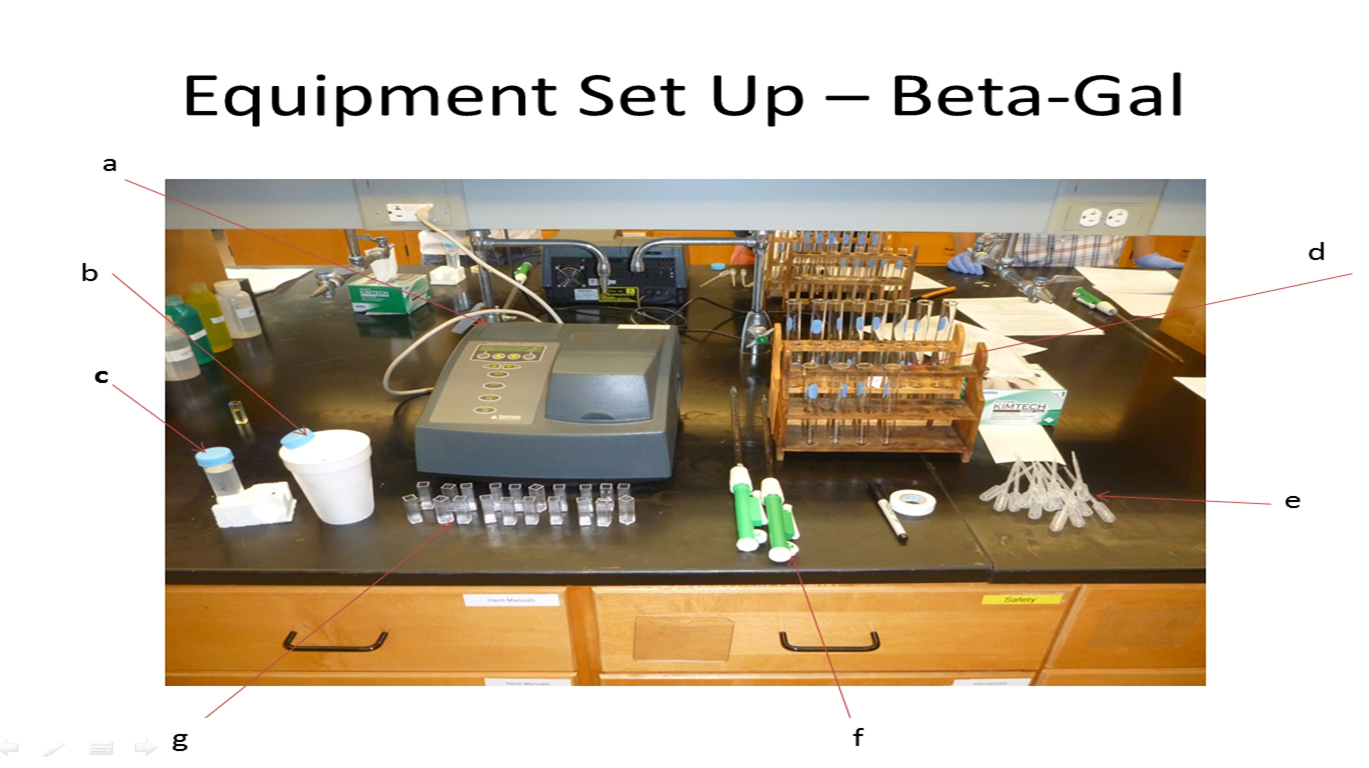
This weekend you will need to read the Beta-Gal Enzyme prelab, which you can find here, you were also given a copy in class.  Answer the prelab questions and make the data table BEFORE coming to lab.  To help you to better visualize the lab set up, take a look at the picture below:


(click the picture to make it larger)

a) spectrophotometer.  Not sure how one of these works?  Watch this one minute video.
b) this cup contains you working enzyme, must be kept on ice.
c) stop solution. You will use this to stop the progress of the reaction
d) test tubes and test tube rack.  Make sure to label all of the tubes using tape and a marker
e) disposable transfer pipettes
f) 5mL and 10mL pipettes.  Fill with 10 mL and use to distribute 1.5 of working enzyme every 15 seconds.
g) cuvettes for the spectrophotemeter.  MAKE SURE TO ONLY TOUCH THE SIDES WITH THE RIDGES.  Wipe only using a Kim-Wipe (lint free cloth) not a paper towel.

Recall the animation that we did in class to manipulate how things like a change in temperature and changing the enzyme substrate concentration impacted enzyme activity.  You can view that animation here.

Tuesday, September 11, 2012

Termite Lab & Metabolism

This week we had our first lab of the year: The termite trails mystery!   C period your lab write up is to be submitted through Blackboard & Turnitin by the start of class on Monday September 17th, D period, your lab is to be submitted through Blackboard & Turnitin by the start of class on Tuesday September 18th.

You have a test tomorrow on Modules 1, 2 and 4.  If you have extended time, we have spoken about you coming to class early or staying through consultation.

In the non-lab period this week, we discussed the highlights of Module 23: Metabolism.

Tuesday, February 7, 2012

Gel Electrophoresis Pictures

Today G period practiced using gel electrophoresis and got great results! After practicing micro-pipetting and learning how to read the 2-20uL and 20-200uL pipettes, students were ready to decide what color (or mixture) of colors to load in their gels (the ideal volume for the wells is 8uL). Check out the pictures of the set up below.
Materials for the lab (and our class mascot).

A gel loaded and ready to be run.

The new BioRad Power Packs are amazing!  We ran two gels at a time for 18 minutes, at 300V and had great results.

Even after only two minutes, you can start to see the green dye in lane 1 has separated out into blue and yellow dye.

A finished gel after 18 minutes at 300V.

Notice how the black food coloring is actually made out of orange and purple dye.  Can you determine which molecules of dye are the largest and which are the smallest?

Marcela records her results.

Antonia and Milly record their results.

Wednesday, February 1, 2012

Strawberry DNA Extraction

Today we extracted DNA from strawberries and had great results!


C period Homework:  Complete the gel electrophoresis virtual lab. Click here to link to the virtual lab.  Take notes on gel electrophoresis.  You will have a short reading quiz on Friday before we actually do gel electrophoresis.

G period: No homework (unless you want to do the virtual lab, so you don't have homework on Thursday night).

Friday, November 11, 2011

Elodea & Snails Lab Report Rubric

Now that you have had the chance to analyze your results and discuss weaknesses/limitations and improvements, it's time to write a lab report. Your lab report is due Wednesday November 16th at the start of class. You must bring a printed copy to class. The rubric is posted below and it has also been emailed to you.  Click on the picture to make it larger.