Tuesday, November 27, 2012

The BIG ideas for the Nervous System

Below are our objectives for the next two weeks.  You will get a copy of these objectives tomorrow in class.  The blank at the start of the objective is for you to write down the date(s) what you learned this material.  The blank at the end of the objective is for you to give yourself a score on how well you understand the material.


____N.1 State that the nervous system consists of the central nervous system (CNS) and peripheral nerves, and is composed of cells called neurons that can carry rapid electrical impulses. ___
___N.2 Draw and label a diagram of the structure of a motor neuron. Include dendrites, cell body with nucleus, axon, myelin sheath, nodes of Ranvier and motor end plates. ______
___N.3 Explain the levels of organization in the peripheral nervous system. ______
___N.4 State that nerve impulses are conducted from receptors to the CNS by sensory neurons, within the CNS by relay neurons, and from the CNS to effectors by motor neurons. ______
___N.5 Define resting potential and action potential (depolarization and repolarization). ______
___N.6 Explain how a nerve impulse passes along a non-myelinated neuron. ______
___N.7 Explain how the movement of Na+ and K+ ions to create a resting potential and an action potential.  ___
___N.8 Explain the principles of synaptic transmission. Include the release, diffusion and binding of the neurotransmitter, initiation of an action potential in the post-synaptic membrane, and subsequent removal of the neurotransmitter. ______
___N.9 Compare Parkinson’s Disease and multiple sclerosis with respect to the ways in which neurons are effected ______
___N.10 Identify factors which can lead to changes in communication between neurons.____
___N.11 Describe the major structures and functions of the vertebrate brain. ______
___N.12  Summarize the diversity of nervous systems in living things. _____

Always be thinking about how what you are learning relates to the themes of the course

Welcome Back!

Today we briefly discussed what you would like to learn about regarding the nervous system.  You also took a pre-test on DNA structure, replication, transcription and translation.

Tuesday, November 13, 2012

Practice Test Questions from Class


pExplain why birds excrete uric acid, humans excrete urea and many marine animals excrete ammonia.
pDefine the two types of feedback systems and give an example of each one.
pDo larger or smaller organisms consume more total oxygen, and why? Which consumes more oxygen per gram of body mass and why?
pWhat are the evolutionary advantages and disadvantages of poikilotherms and homeotherms?
pDescribe how freshwater fish and saltwater fish differ in homeostasis.

Above are some of the questions C period came up with today while working with Bloom's taxonomy to review for tomorrow's test.


Monday, November 12, 2012

Suspended Animation is Within Our Grasp

We have been learning about homeostasis, focusing on thermoregulation, osmoregulation and an organism's overall energy needs.

Mark Roth's talk "Suspended Animation is Within Our Grasp" ties together all of the things we have been learning about in class.


Crayfish Prelab

You have been emailed the crayfish prelab.  Below is a PowerPoint with what you will see when you walk into lab as well as some background on crayfish.

UPDATE: You do not need to answer question six on the prelab.


Thursday, November 8, 2012

Epic Kidney Animation and Homework for Wednesday

Yesterday you worked in groups to review what you saw in the video last night.  After putting all of your ideas on the board, you toured the other groups work, asking questions and adding comments.

We reviewed some of the major concepts in the crash course video as well as learned about ADH (anti-diuretic hormone).    Click the picture below to link to the animation.


D period - Because of Hill weekend, we do not have class on Saturday.  Your homework for Monday is to read Module 144. You have been emailed your pre-lab for the crayfish lab.  The prelab is due on Tuesday at the start of lab.

C period - read Module 144 for class on Friday.  You have been emailed your pre-lab for the crayfish lab.  The prelab is due on Monday at the start of lab.

Tuesday, November 6, 2012

Osmoregulation and The Kidney

Today you had a reading quiz on osmoregulation and we started to look at how waste is expelled though the body.

Tonight watch the Crash Course video below.  Watch it once and ONLY watch.  Don't write anything down as you watch.  When the video is finished, take five minutes and write down what you remember.  Then watch the video a second time.  Again ONLY watch. At the end of the video, write down what you remember the second time.  Did you remember something new?  Are you building on what you wrote down the first time?


And in honor of election day, check out "Behind the Curtain Project" that documents atypical polling locations.

click the picture to get to the site.

Monday, November 5, 2012

Welcome Back to Homeostasis

Before Hurricane Sandy, we started to learn about homeostasis and the importance of maintaining balance in an organism's body.  Today we reviewed Module 128: Temperature (Thermoregulation) and you worked on a case study on Hibernation (C period, D period will have the case study tomorrow).

Tonight please read Module 157, focus the differences between osmoconformers and osmoregulators.  Take notes, you will have a 15 minute reading quiz on Tuesday.  Any notes you take, you can use.  

Please be sure to refer to the updates on the Honors Biology Daily Plan google doc to see how we are finishing up the term.  

Wednesday, October 24, 2012

Test Today and Homework for Tuesday

Today you had a test on cellular respiration and photosynthesis.  For Tuesday, please read Module 128.  Bring to class an outline of what you thought were the key concepts in the reading.  Click the picture below to link to a tutorial on homeostasis.


Homeostasis

On Monday / Tuesday we started to learn about homeostasis.


You did a jig saw activity to see how carbon dioxide, blood pressure and temperature regulation can all be regulated through feedback mechanisms.  Click the picture below to link to a tutorial on feedback mechanisms in our bodies.


Monday, October 22, 2012

DPIP Post Lab

Create a line graph that includes each of your five cuvettes and the class average for cuvette 3.  The data is available on the google doc, however you should create your graph in excel. There is no excel tutorial for this post lab, however you can click here to get to the previous excel tutorials.

Be sure to include a scientific title, appropriate labels and a description of the graph.

Post Lab Question: Evaluate the weaknesses and limitations of this experiment.  Identify (at least) three weaknesses, explain the impact this could have on the experiment and how you could improve this in the future. Consider creating a table like the one below to organize your ideas.


Weakness
Impact on Experiment
Improvement


Saturday, October 20, 2012

Cellular Respiration and Photosynthesis

Yesterday (and today) we wrapped up cellular respiration and photosynthesis as a class.  Check out the links under the tab "Cellular Respiration and Photosynthesis" to help you review all of the aspects of these concepts.

Friday, October 19, 2012

DPIP Lab Set Up

Below are the pictures of the set up for the DPIP lab. You have used a spectrophotometer before, however this time you will be measuring transmission, instead of absorbance.


Spectrophotometer set up

Paper chromatography set up.  Reminder: you can read about paper chromatography and see an animation here.

Chloroplasts and DPIP on ice.  Note: I pulled the vials out of the ice for the picture,  however these should remain buried under ice when not in use. 


Thursday, October 18, 2012

Test on Wednesday October 24th

This is just a reminder that on Wednesday Oct 24th, you will have a test on osmosis, diffusion, cellular respiration and photosynthesis.

You are not responsible for knowing the intermediaries in the Calvin Cycle (photosynthesis) nor in the Krebs / Citric Acid Cycle (cellular respiration).

We will wrap up cellular respiration and photosynthesis tomorrow.

Tuesday, October 16, 2012

DPIP (Photosynthesis Prelab)

Below are the links that are in the prelab:

For lab next week, you need to complete the background in the prelab (using the links), as well as the prelab questions at the end of the packet (and make data tables!!)

NOTE: There will be no phosphate buffer in the lab, so change the table on page three of the lab to the table below.


Monday, October 15, 2012

Wrapping up Cellular Respiration and Starting Photosynthesis

Today we wrapped up cellular respiration with this modified multiple choice question (and for D period, a play-doh review of the ETC).


Still struggling to remember how the electron transport chain works?  Listen to the song from Muscles and Magnets titled "Oxidative Phosphorylation."  Click on the lyrics below to link to the song file.


Homework: Read M31 (remember to follow the instructions on how to efficiently read the module).  Use the Virtual Cell's Animation on the Light Dependent Reactions or Crash Course's Explanation of Photosynthesis.

Thursday, October 11, 2012

Reminders for reading about Cellular Respiration

A reminder about your reading (Module 26) for next class (Friday or Saturday).  Please focus on the key concepts and remember the big picture.  Use the Virtual Cell's Animation of the Electron Transport Chain (either watch the video or if the internet is slow, click through the pictures).

Wednesday, October 10, 2012

Osmosis & Diffusion Post Lab Update

Below are the requirements for the Osmosis & Diffusion Post Lab:

1. This is due Friday October 19th (C period) or Saturday October 20th (D period)
2. Please bring a printed copy to class to turn in.
3. Prior to turning in your post-lab, complete the rubric.  You will receive a copy of the rubric in class (but you can also find it below). Review your work and give yourself a score for each required component.  

If you are struggling to organize your data or are unsure of how to calculate percent change, watch the five minute tutorial below.  

Click play to view the screencast in a new window.


Tuesday, October 9, 2012

Osmosis & Diffusion Lab

Yesterday and today students were able to see how water will move down its concentration gradient.


Color coded sugar solutions, thanks Ted and Val!

Parts 2 and 3 of the experiment: dialysis bags with sugar solution and getting the potato cubes ready.
Today C period will collect the final mass of their potato cubes, D period will collect this data tomorrow.  The post lab for this is due on Tuesday Oct 16th for C period and on Wednesday Oct 17th for D period.

I email you the class data in an Excel file.


Friday, October 5, 2012

Osmosis and Diffusion Prelab

Below is your osmosis and diffusion prelab.  Note: Page 3 only has two lines of text, make sure you continue to scroll down!!

Tuesday, October 2, 2012

Membranes, Osmosis & Diffusion

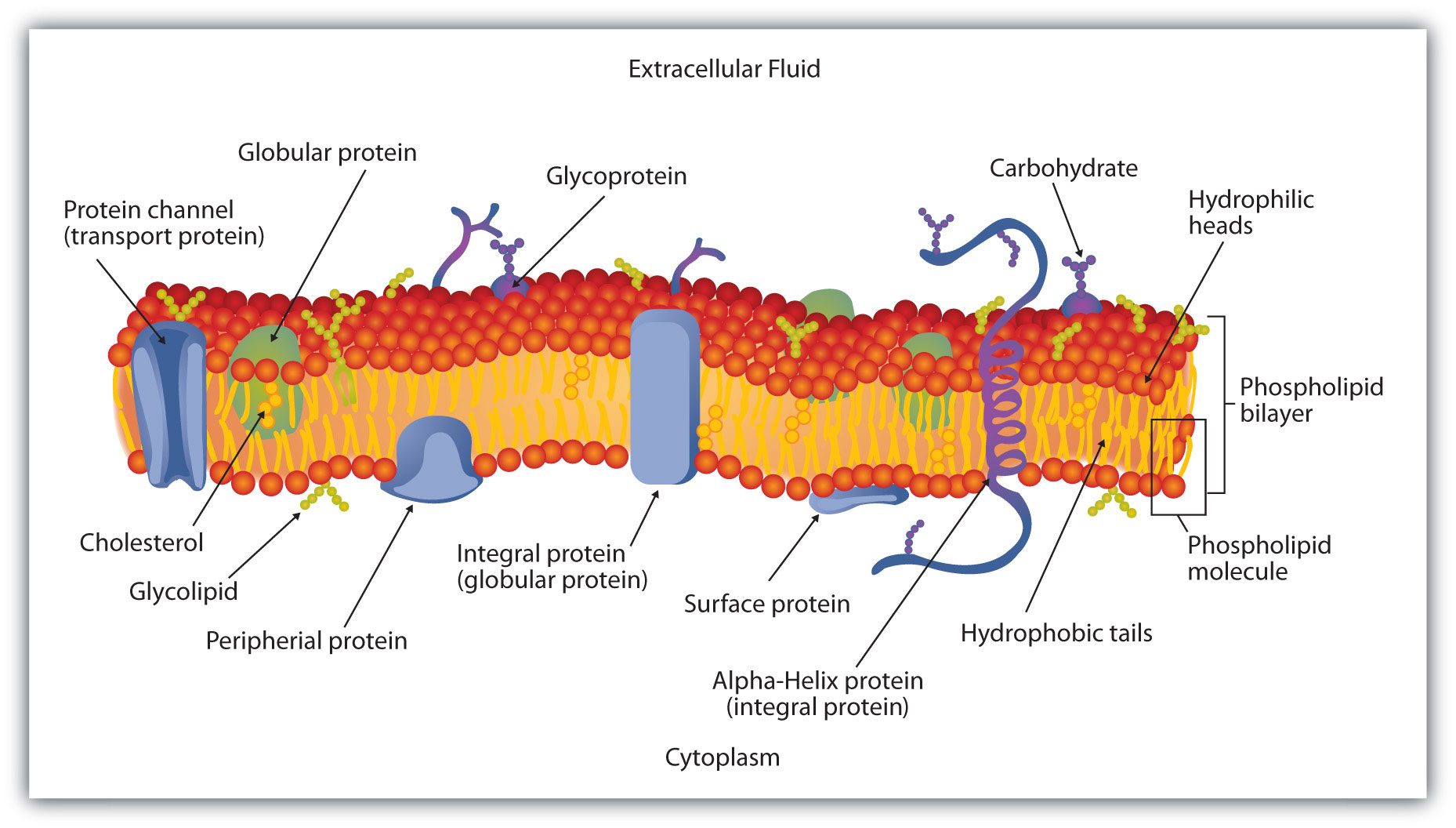
Today we discussed the details of the cell membrane.  What is it made out of?  As well as how do things move from one side to the other.

http://images.flatworldknowledge.com/ballgob/ballgob-fig17_008.jpg

Concentration gradients help drive the movement of substances in and out of a cell, which in turn relates to osmosis and diffusion.  Here's the animation on osmosis and diffusion that we watched in class.

Homework: Study for your test tomorrow.

Monday, October 1, 2012

Organelles Concept Map

Today you worked on connecting organelles and their functions, as well as identifying if the metabolic pathways were catabolic or anabolic. Below is the concept map you received in class.

Tomorrow D period will wrap up organelles and move on to the cell membrane, osmosis and diffusion.  C period you will learn about osmosis and diffusion.


Thursday, September 27, 2012

Using Excel to Process the B-gal Lab Data

In an attempt to help everyone work at his/her own pace with Excel, below are two video tutorials on how to use Excel to process the data from the Beta-gal lab.  You have all been emailed the class data to work with.

Click on the video button to play the screencast for how to calculate enzyme activity.

Click on the video button to play the screencast for how to calculate variance, create a scatter plot and insert custom error bars.
Below are your post lab questions.  These are due Monday for C period and Tuesday for D period.

Wednesday, September 26, 2012

Winning Lab!

Congratulations to C period's lab winner: Victoria and Celeste, as well as D period's lab winners: Coco and Aiko.  Major changes have been made to our schedule over the next few weeks, so please refer to the google doc, so you can appropriately mangage your time.

Please bring your computer to our next class and if you haven't yet emailed me your data, please so so!

Saturday, September 22, 2012

Cells!

Today (or yesterday) you had a quiz on enzymes, ATP and metabolism.  After the quiz we review the prelab (below).  With the remaining time in class we started talking about cells.  We created our own neural pathway with our hands and saw just how many cell types were used.  We also started to watch the crash course video below:   Cell City.

Your homework over the weekend is to do the prelab.


Friday, September 21, 2012

Beta Gal Enzyme Pre-Lab

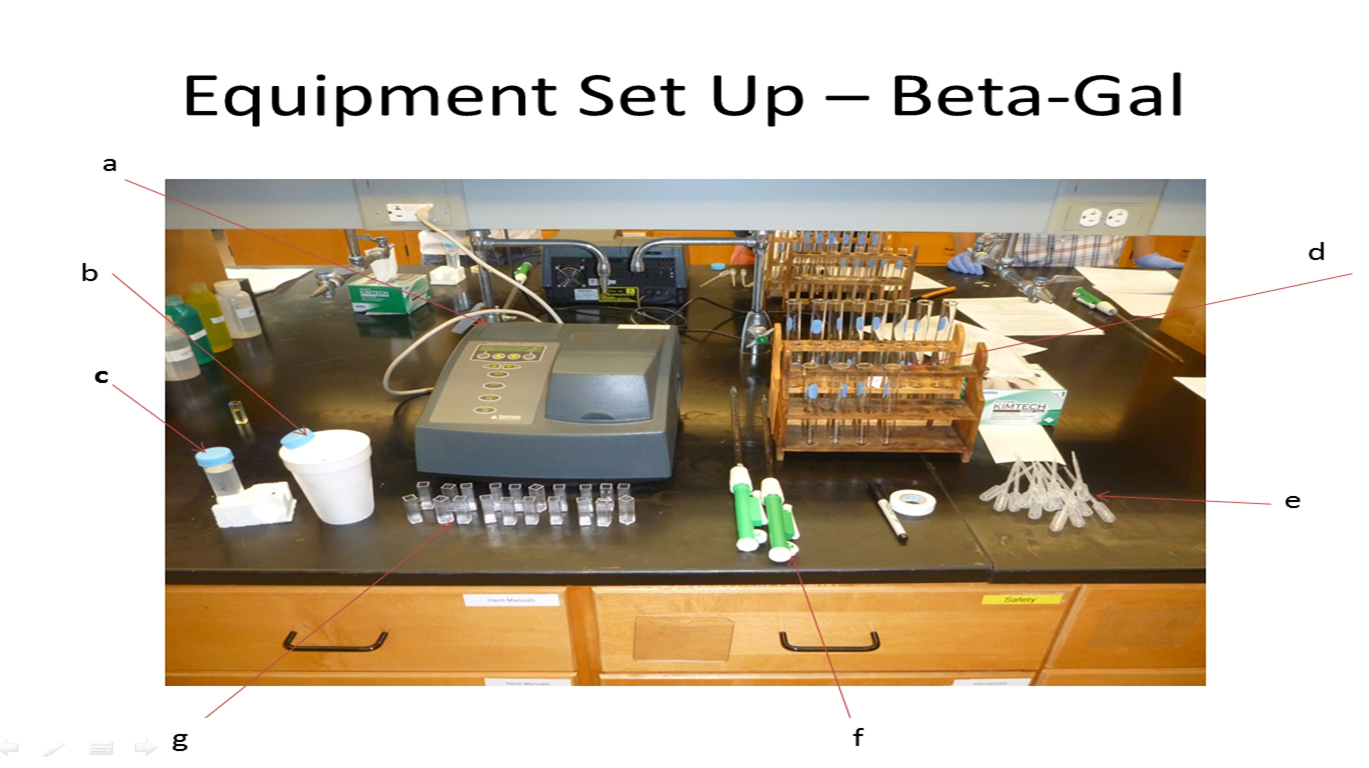
This weekend you will need to read the Beta-Gal Enzyme prelab, which you can find here, you were also given a copy in class.  Answer the prelab questions and make the data table BEFORE coming to lab.  To help you to better visualize the lab set up, take a look at the picture below:


(click the picture to make it larger)

a) spectrophotometer.  Not sure how one of these works?  Watch this one minute video.
b) this cup contains you working enzyme, must be kept on ice.
c) stop solution. You will use this to stop the progress of the reaction
d) test tubes and test tube rack.  Make sure to label all of the tubes using tape and a marker
e) disposable transfer pipettes
f) 5mL and 10mL pipettes.  Fill with 10 mL and use to distribute 1.5 of working enzyme every 15 seconds.
g) cuvettes for the spectrophotemeter.  MAKE SURE TO ONLY TOUCH THE SIDES WITH THE RIDGES.  Wipe only using a Kim-Wipe (lint free cloth) not a paper towel.

Recall the animation that we did in class to manipulate how things like a change in temperature and changing the enzyme substrate concentration impacted enzyme activity.  You can view that animation here.

Wednesday, September 19, 2012

Enzyme Concept Map

Today in class you created a concept map for enzymes.  Below is a sample map that I created.

Homework: Read Module 14 for your next class.  Since you have the quiz on ATP, Metabolism and Enzymes, you only need to read pages 70 and 73.


Tuesday, September 18, 2012

Enzymes

Here's what we know so far about enzymes:

Enzymes are a biological catalyst
They are proteins (which are made out of amino acids)
Enzymes lower the activation energy of a chemical reaction
Enzymes have optimum ranges of temperature and pH where they work best
Bind to substrates at specific active sites
Extremes for pH and/or temperature can denature enzymes (meaning the shape changes and it can no longer bind to the substrate)
Might not function properly if the DNA which encodes the enzyme is damaged.
Involved with both anabolic and catabolic reactions:
    examples: anabolic enzyme = ATP synthase
                     catabolic enzyme = lactase
Many enzymes end in "ase."
Enzymes are not used up in chemical reactions.

Below are links to the enzyme animations we used in class
Basic enzyme function
ATP Synthase (movie)
Manipulating factors that effect enzyme productive (temp, pH)

Homework: C period - Read Module 12 for class tomorrow
D period - complete termite lab, submit via EMAIL.

Monday, September 17, 2012

Wrapping up ATP and Starting Enzymes

Today both classes tied together ATP and metabolism, using a lab activity created by Mr. Hansen.  In this activity you needed to actually perform dehydration synthesis and identify ATP formation as an anabolic process.

Tonight you attend a screening of Journey of the Universe.  I look forward to hearing your thoughts about the video tomorrow.

Tomorrow C period will start to learn about enzymes, while D period takes a closer look at primary literature on ATP and mitochondria.

Friday, September 14, 2012

Videos on cellular work and ATP hydrolysis

Today we took some time to clarify misconceptions about energy and ATP.  Below are the videos we used to help improve our understanding.

All of this is inside your cell!  The Kinesin motor protein starts at 1:16.


How the kinesin motor protein works


ATP Hydrolysis (up to 3:30 - we haven't discussed cellular respiration yet).


We didn't have time to watch this video on misconceptions about heat and temperature, but it is pretty nifty.

Wednesday, September 12, 2012

Test Today

Today students had a test on Modules 1, 2 and 4.

C period: we will not meet again until Monday.  Please read Module 24 for Monday.  There is no lab on Monday, so you do not need to wear closed toed shoes, however, we will be working for the entire period.

Reminder: Your termite lab write up is due by 10:45am on Monday though Blackboard.

D period: Please read Module 24 for class on Friday.

Reminder: Your termite lab write up is due by 10:45am on Tuesday though Blackboard. 

Tuesday, September 11, 2012

Termite Lab & Metabolism

This week we had our first lab of the year: The termite trails mystery!   C period your lab write up is to be submitted through Blackboard & Turnitin by the start of class on Monday September 17th, D period, your lab is to be submitted through Blackboard & Turnitin by the start of class on Tuesday September 18th.

You have a test tomorrow on Modules 1, 2 and 4.  If you have extended time, we have spoken about you coming to class early or staying through consultation.

In the non-lab period this week, we discussed the highlights of Module 23: Metabolism.

Saturday, September 8, 2012

Homework Update

C period: Read Module 4 for Monday and Module 23 for Tuesday

D period:  Read Module 23 for Monday and Module 4 for Tuesday

3-2-1 Reflections are now due Tuesday by 8PM.  Please make sure to write at the top of each entry "For the week of _______" so you can keep track of the days for which you are submitting the assignment.  You may submit the assignment as early as Saturday after classes.

Friday, September 7, 2012

Chains notes on Module 2

Today students used chain notes to examine their understanding of Module 2.  We'll be learning more about ATP in Modules 23 and 24.

For your next class, read Module 4.  We will being doing our first lab of the year, so please remember to bring the lab safety contracts to class.  You need to wear closed toed shoes to lab.

In both classes we talked about mushrooms as decomposers, so if tonight you aren't enticed by the Mesh Mash, check out Jae Rhim Lee's TED Talk: My mushroom burial suit.

Wednesday, September 5, 2012

Giraffe Follow Up

Today we briefly discussed the alternative theory as to why giraffes have long necks.  An emerging idea, from Robert E. Simmons and Lue Scheepers is that giraffes use their necks as weapons, and it is sexual selection, not the height of their food that is the driving force behind long necks.

Click the picture to link to the article.

Below are two videos of giraffe behavior.  The first one is how males use their necks to fight, the second video displays the Flehmen response. 


Natural Selection

Today students took a short quiz on Module 1: Evolution and Life on Earth.  To expand on our understanding of natural selection, students completed a jigsaw activity using the articles below.  The objective was to see how the species described in the article underwent the four components of natural selection.  

How diversity creates itself – cascades of new species among flies and parasitic wasps

Butterflies evolve resistance to male-killing bacteria in record time

Mud time capsules show evolutionary arms race between host and parasite 

Homework: Read module 2: Energy & Matter (pages 10-12).  Full disclosure: There's a substantial amount of vocab in these few pages.  

Tuesday, September 4, 2012

It's Alive! ....but maybe not

Today we debated if the Biological Wonder was alive.  One thing we could agree on is that all living things use energy.  This will be important in our next topic.  We also continued discussing how to study giraffes and the evolutionary reason for their long necks.

Reminder: Tomorrow you will have a quiz on Module 1.

Monday, September 3, 2012

Inquiry Cubes

http://tinyurl.com/chnhr9g 
Your challenge today was to work together to make a reasonable hypothesis about the number (or name and numbers) on the bottom of two different inquiry cubes.  What's on the bottom of the cube will remain a mystery, because in science we can rarely gather every piece of the puzzle and eliminate all doubt.  

Your homework tonight is to read the critical thinking framework. We will be using this document throughout the year, so you do not need to memorize it, just focus on the main themes.  

Tomorrow we will start (D period) or finish (C period) the giraffe case study as well as have another inquiry challenge.  

A Critical Thinking Framework for Understanding Excellence in Biological Thinking


A critical thinking framework for understanding excellence in biological thinking from ilanasaxe

If you would like to save the document to your computer, click the "slideshare" button on the bottom left page of the document. You can also use this to print the document.

Sunday, September 2, 2012

Homework, Computers & Book Update

There is no homework for this weekend because everyone does not have access to the book. 

If you have a laptop / tablet or iPad, please bring it to class tomorrow.  Additionally if you were able to purchase an access code through class books, please bring that as well.  For those of you who have not already purchased the book, we now have the access codes and I will distribute them to you in class.

Friday, August 31, 2012

Welcome to Honors Biology at Lawrenceville!

Welcome to our class website.  Homework, announcements about upcoming assessments and resources to help you with these assessments will be posted here.  If you find something that you think would be helpful for the rest of the class to have, send it along and I will post it on the blog.

Today students took a short pre-assessment to gauge how much they know about evolution and the relationship between matter and energy.


UPDATE: You will be getting an email from Mr. Hansen with information about your book.  Even if you already have the access code, there will be information in that email that will pertain to you.