
Wednesday, October 24, 2012
Test Today and Homework for Tuesday
Today you had a test on cellular respiration and photosynthesis. For Tuesday, please read Module 128. Bring to class an outline of what you thought were the key concepts in the reading. Click the picture below to link to a tutorial on homeostasis.

Homeostasis
On Monday / Tuesday we started to learn about homeostasis.

You did a jig saw activity to see how carbon dioxide, blood pressure and temperature regulation can all be regulated through feedback mechanisms. Click the picture below to link to a tutorial on feedback mechanisms in our bodies.


You did a jig saw activity to see how carbon dioxide, blood pressure and temperature regulation can all be regulated through feedback mechanisms. Click the picture below to link to a tutorial on feedback mechanisms in our bodies.
Monday, October 22, 2012
DPIP Post Lab
Create a line graph that includes each of your five cuvettes and the class average for cuvette 3. The data is available on the google doc, however you should create your graph in excel. There is no excel tutorial for this post lab, however you can click here to get to the previous excel tutorials.
Be sure to include a scientific title, appropriate labels and a description of the graph.
Post Lab Question: Evaluate the weaknesses and limitations of this experiment. Identify (at least) three weaknesses, explain the impact this could have on the experiment and how you could improve this in the future. Consider creating a table like the one below to organize your ideas.
Be sure to include a scientific title, appropriate labels and a description of the graph.
Post Lab Question: Evaluate the weaknesses and limitations of this experiment. Identify (at least) three weaknesses, explain the impact this could have on the experiment and how you could improve this in the future. Consider creating a table like the one below to organize your ideas.
Weakness
|
Impact on Experiment
|
Improvement
|
Saturday, October 20, 2012
Cellular Respiration and Photosynthesis
Yesterday (and today) we wrapped up cellular respiration and photosynthesis as a class. Check out the links under the tab "Cellular Respiration and Photosynthesis" to help you review all of the aspects of these concepts.
Friday, October 19, 2012
DPIP Lab Set Up
Below are the pictures of the set up for the DPIP lab. You have used a spectrophotometer before, however this time you will be measuring transmission, instead of absorbance.
 |
| Spectrophotometer set up |
 |
| Paper chromatography set up. Reminder: you can read about paper chromatography and see an animation here. |
 |
| Chloroplasts and DPIP on ice. Note: I pulled the vials out of the ice for the picture, however these should remain buried under ice when not in use. |
Thursday, October 18, 2012
Test on Wednesday October 24th
This is just a reminder that on Wednesday Oct 24th, you will have a test on osmosis, diffusion, cellular respiration and photosynthesis.
You are not responsible for knowing the intermediaries in the Calvin Cycle (photosynthesis) nor in the Krebs / Citric Acid Cycle (cellular respiration).
We will wrap up cellular respiration and photosynthesis tomorrow.
You are not responsible for knowing the intermediaries in the Calvin Cycle (photosynthesis) nor in the Krebs / Citric Acid Cycle (cellular respiration).
We will wrap up cellular respiration and photosynthesis tomorrow.
Tuesday, October 16, 2012
DPIP (Photosynthesis Prelab)
Below are the links that are in the prelab:
For lab next week, you need to complete the background in the prelab (using the links), as well as the prelab questions at the end of the packet (and make data tables!!)
 NOTE: There will be no phosphate buffer in the lab, so change the table on page three of the lab to the table below.

Monday, October 15, 2012
Wrapping up Cellular Respiration and Starting Photosynthesis
Today we wrapped up cellular respiration with this modified multiple choice question (and for D period, a play-doh review of the ETC).

Still struggling to remember how the electron transport chain works? Listen to the song from Muscles and Magnets titled "Oxidative Phosphorylation." Click on the lyrics below to link to the song file.


Still struggling to remember how the electron transport chain works? Listen to the song from Muscles and Magnets titled "Oxidative Phosphorylation." Click on the lyrics below to link to the song file.
Homework: Read M31 (remember to follow the instructions on how to efficiently read the module). Use the Virtual Cell's Animation on the Light Dependent Reactions or Crash Course's Explanation of Photosynthesis.
Thursday, October 11, 2012
Reminders for reading about Cellular Respiration
A reminder about your reading (Module 26) for next class (Friday or Saturday). Please focus on the key concepts and remember the big picture. Use the Virtual Cell's Animation of the Electron Transport Chain (either watch the video or if the internet is slow, click through the pictures).
Wednesday, October 10, 2012
Osmosis & Diffusion Post Lab Update
Below are the requirements for the Osmosis & Diffusion Post Lab:
1. This is due Friday October 19th (C period) or Saturday October 20th (D period)
2. Please bring a printed copy to class to turn in.
3. Prior to turning in your post-lab, complete the rubric. You will receive a copy of the rubric in class (but you can also find it below). Review your work and give yourself a score for each required component.
If you are struggling to organize your data or are unsure of how to calculate percent change, watch the five minute tutorial below.
 |
| Click play to view the screencast in a new window. |
Tuesday, October 9, 2012
Osmosis & Diffusion Lab
Yesterday and today students were able to see how water will move down its concentration gradient.
.JPG)
Today C period will collect the final mass of their potato cubes, D period will collect this data tomorrow. The post lab for this is due on Tuesday Oct 16th for C period and on Wednesday Oct 17th for D period.
.JPG)
Color coded sugar solutions, thanks Ted and Val!
 |
| Parts 2 and 3 of the experiment: dialysis bags with sugar solution and getting the potato cubes ready. |
I email you the class data in an Excel file.
Friday, October 5, 2012
Osmosis and Diffusion Prelab
Below is your osmosis and diffusion prelab. Note: Page 3 only has two lines of text, make sure you continue to scroll down!!
Tuesday, October 2, 2012
Membranes, Osmosis & Diffusion
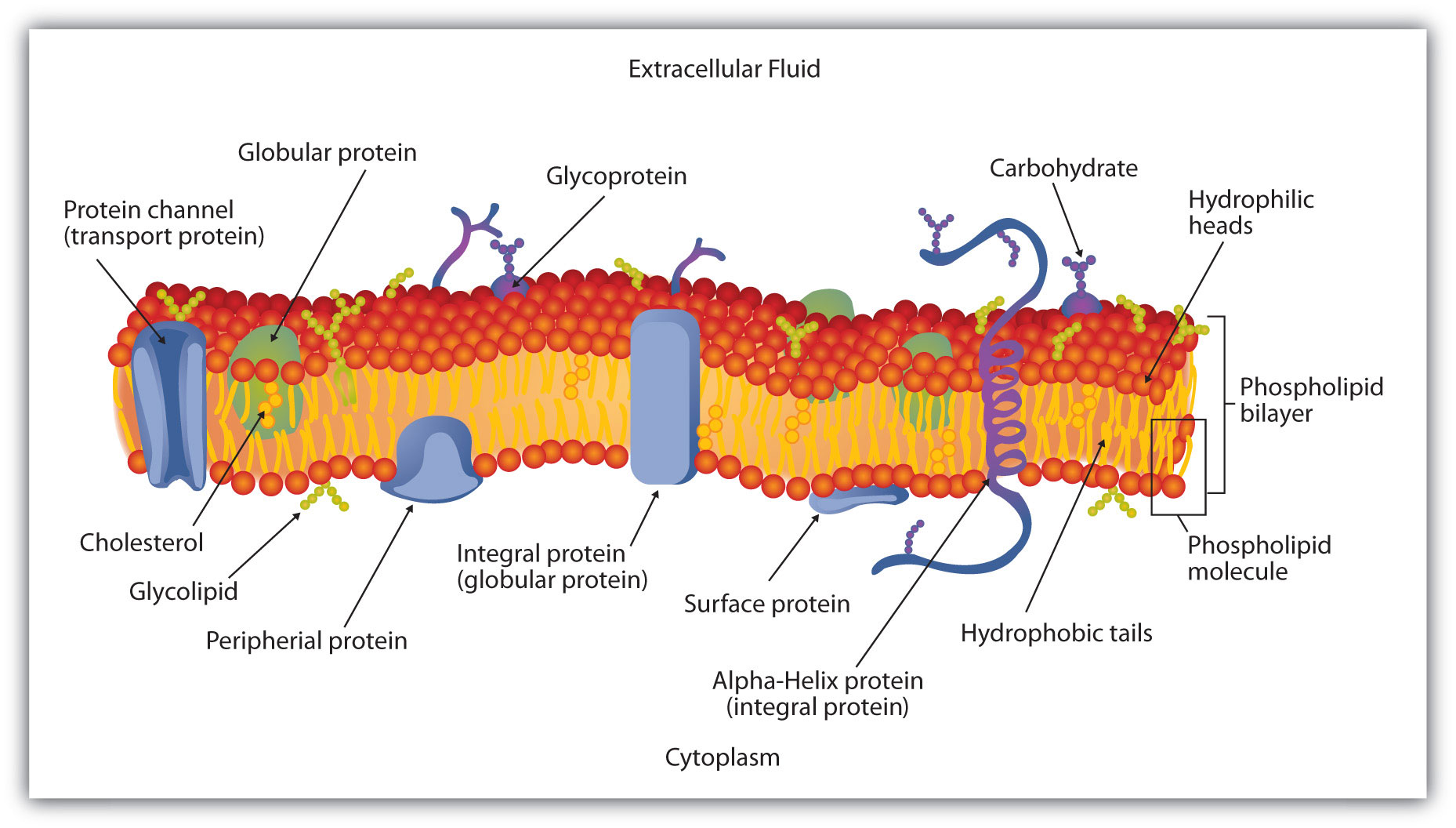
Today we discussed the details of the cell membrane. What is it made out of? As well as how do things move from one side to the other.
Concentration gradients help drive the movement of substances in and out of a cell, which in turn relates to osmosis and diffusion. Here's the animation on osmosis and diffusion that we watched in class.
Homework: Study for your test tomorrow.
 |
| http://images.flatworldknowledge.com/ballgob/ballgob-fig17_008.jpg |
Concentration gradients help drive the movement of substances in and out of a cell, which in turn relates to osmosis and diffusion. Here's the animation on osmosis and diffusion that we watched in class.
Homework: Study for your test tomorrow.
Monday, October 1, 2012
Organelles Concept Map
Today you worked on connecting organelles and their functions, as well as identifying if the metabolic pathways were catabolic or anabolic. Below is the concept map you received in class.
Tomorrow D period will wrap up organelles and move on to the cell membrane, osmosis and diffusion. C period you will learn about osmosis and diffusion.
Tomorrow D period will wrap up organelles and move on to the cell membrane, osmosis and diffusion. C period you will learn about osmosis and diffusion.
Thursday, September 27, 2012
Using Excel to Process the B-gal Lab Data
In an attempt to help everyone work at his/her own pace with Excel, below are two video tutorials on how to use Excel to process the data from the Beta-gal lab. You have all been emailed the class data to work with.
Below are your post lab questions. These are due Monday for C period and Tuesday for D period.
 |
| Click on the video button to play the screencast for how to calculate enzyme activity. |
 |
| Click on the video button to play the screencast for how to calculate variance, create a scatter plot and insert custom error bars. |
Wednesday, September 26, 2012
Winning Lab!
Congratulations to C period's lab winner: Victoria and Celeste, as well as D period's lab winners: Coco and Aiko. Major changes have been made to our schedule over the next few weeks, so please refer to the google doc, so you can appropriately mangage your time.
Please bring your computer to our next class and if you haven't yet emailed me your data, please so so!
Please bring your computer to our next class and if you haven't yet emailed me your data, please so so!
Saturday, September 22, 2012
Cells!
Today (or yesterday) you had a quiz on enzymes, ATP and metabolism. After the quiz we review the prelab (below). With the remaining time in class we started talking about cells. We created our own neural pathway with our hands and saw just how many cell types were used. We also started to watch the crash course video below: Cell City.
Your homework over the weekend is to do the prelab.
Your homework over the weekend is to do the prelab.
Friday, September 21, 2012
Beta Gal Enzyme Pre-Lab
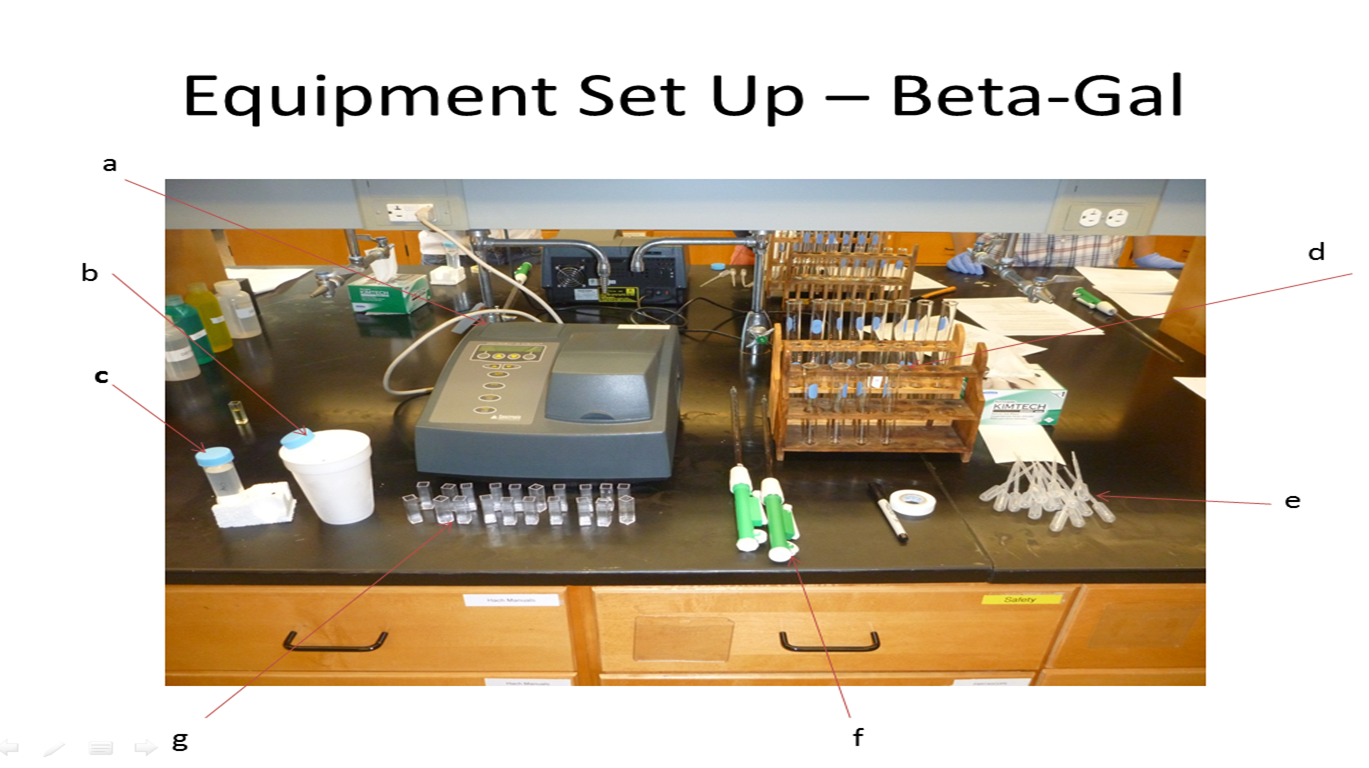
This weekend you will need to read the Beta-Gal Enzyme prelab, which you can find here, you were also given a copy in class. Answer the prelab questions and make the data table BEFORE coming to lab. To help you to better visualize the lab set up, take a look at the picture below:

a) spectrophotometer. Not sure how one of these works? Watch this one minute video.
b) this cup contains you working enzyme, must be kept on ice.
c) stop solution. You will use this to stop the progress of the reaction
d) test tubes and test tube rack. Make sure to label all of the tubes using tape and a marker
e) disposable transfer pipettes
f) 5mL and 10mL pipettes. Fill with 10 mL and use to distribute 1.5 of working enzyme every 15 seconds.
g) cuvettes for the spectrophotemeter. MAKE SURE TO ONLY TOUCH THE SIDES WITH THE RIDGES. Wipe only using a Kim-Wipe (lint free cloth) not a paper towel.
Recall the animation that we did in class to manipulate how things like a change in temperature and changing the enzyme substrate concentration impacted enzyme activity. You can view that animation here.
(click the picture to make it larger)
a) spectrophotometer. Not sure how one of these works? Watch this one minute video.
b) this cup contains you working enzyme, must be kept on ice.
c) stop solution. You will use this to stop the progress of the reaction
d) test tubes and test tube rack. Make sure to label all of the tubes using tape and a marker
e) disposable transfer pipettes
f) 5mL and 10mL pipettes. Fill with 10 mL and use to distribute 1.5 of working enzyme every 15 seconds.
g) cuvettes for the spectrophotemeter. MAKE SURE TO ONLY TOUCH THE SIDES WITH THE RIDGES. Wipe only using a Kim-Wipe (lint free cloth) not a paper towel.
Recall the animation that we did in class to manipulate how things like a change in temperature and changing the enzyme substrate concentration impacted enzyme activity. You can view that animation here.
Wednesday, September 19, 2012
Enzyme Concept Map
Today in class you created a concept map for enzymes. Below is a sample map that I created.
Homework: Read Module 14 for your next class. Since you have the quiz on ATP, Metabolism and Enzymes, you only need to read pages 70 and 73.
Homework: Read Module 14 for your next class. Since you have the quiz on ATP, Metabolism and Enzymes, you only need to read pages 70 and 73.
Tuesday, September 18, 2012
Enzymes
Here's what we know so far about enzymes:
Enzymes are a biological catalyst
They are proteins (which are made out of amino acids)
Enzymes lower the activation energy of a chemical reaction
Enzymes have optimum ranges of temperature and pH where they work best
Bind to substrates at specific active sites
Extremes for pH and/or temperature can denature enzymes (meaning the shape changes and it can no longer bind to the substrate)
Might not function properly if the DNA which encodes the enzyme is damaged.
Involved with both anabolic and catabolic reactions:
examples: anabolic enzyme = ATP synthase
catabolic enzyme = lactase
Many enzymes end in "ase."
Enzymes are not used up in chemical reactions.
Below are links to the enzyme animations we used in class
Basic enzyme function
ATP Synthase (movie)
Manipulating factors that effect enzyme productive (temp, pH)
Homework: C period - Read Module 12 for class tomorrow
D period - complete termite lab, submit via EMAIL.
Enzymes are a biological catalyst
They are proteins (which are made out of amino acids)
Enzymes lower the activation energy of a chemical reaction
Enzymes have optimum ranges of temperature and pH where they work best
Bind to substrates at specific active sites
Extremes for pH and/or temperature can denature enzymes (meaning the shape changes and it can no longer bind to the substrate)
Might not function properly if the DNA which encodes the enzyme is damaged.
Involved with both anabolic and catabolic reactions:
examples: anabolic enzyme = ATP synthase
catabolic enzyme = lactase
Many enzymes end in "ase."
Enzymes are not used up in chemical reactions.
Below are links to the enzyme animations we used in class
Basic enzyme function
ATP Synthase (movie)
Manipulating factors that effect enzyme productive (temp, pH)
Homework: C period - Read Module 12 for class tomorrow
D period - complete termite lab, submit via EMAIL.
Subscribe to:
Posts (Atom)