Monday, September 19, 2011

Parts of a Lab Report

Today (or tomorrow for G period) we learned about the parts of a lab report.  The first PowerPoint below details the parts of a lab report.  The second PowerPoint shows you how to make an x y scatter plot in Excel.  Lastly, there is an image of the rubric that you will need to turn in when you submit your lab report.  You can not turn in a lab report without the rubric.  If you don't have the rubric and self-evaluation completed, your lab report will be late.
Tips for working in Excel: Remember that your graph should display the average for the five beans in each group (0.0g salt, 0.5g salt etc).


Insert a blank row, below the data for bean 1e.  To do this, highlight row 7 (bean 2a), go to "Insert" and select "row."  A new row should appear directly below 1e.  The row in the screen shot is yellow, because I added the color to make it easier to see.

You can click on any of the images below to make them larger.

Directly below 0.41, type =average (as you start to do this a menu will appear and you can select AVERAGE.
 Now the cell (square) below 0.41 should look like the picture below.
 Highlight the data for which you want to take the average.  Once you have highlighted these numbers, press Enter (Return).

You should now have an 0.38 in the box where you originally typed =AVERAGE . Place the cursor so that it touches the lower right corner of the highlighted blue box.  A black plus sign (+) should appear.  Drag this symbol directly across the row and this will give you the averages for the rest of the data for group 1.

Once you have all of the averages completed, you are ready almost to make an X Y scatter plot.  You will want to open either a new spreadsheet or a new tab in Excel.  Make a data table that contains the averages (see below).
Now you are ready to click through the PowerPoint below and make an X Y scatter plot.
Making an xy scatter plot
View more presentations from ilanasaxe

And just in case you 'misplaced' the rubric, you can see it (and print it) from the image below. 

Friday, September 16, 2011

Properties of Water

Today students had a reading quiz on section 2.2 and we learned about the properties of water.  In our seeds and salt experiment, we saw how plants take advantage of the cohesive and adhesive properties of water to take in water through their roots.  Many of us experienced evaporative cooling in class over the past few days.  If you go swimming in Lake Lugano or tubing at Lago Maggiore over the weekend, you'll be taking advantage of water's high specific heat (even though it has been cool at night, the lakes are still warm).  So even without realizing it, you benefit from the unique properties of water everyday.

There is no homework due Monday.  If you are unsure about the pH scale, click the picture below to link to an interactive pH scale.  Use the brown arrows in the lower left of the animation to navigate.  The interactive pH scale is on the third slide.

Thursday, September 15, 2011

Homework for Friday

Read section 2.2 and take notes for a reading quiz.  Also, check out G period's bean seeds!


 Tomorrow will be our last day of collecting data for the seeds & salt experiment.  Unfortunately, C period's experiment was cut short due to the growth of mold on the seeds and in the dishes.  In G period's experiment, only one dish showed signs of mold.  Perhaps that's something that could be used in your discussions of the experiment.....


Wednesday, September 14, 2011

Chapter 2 - Radioactive Dating, Chemical Bonds and the Properties of Water

G Period: Today students collected data from the seeds & salt experiment. After collecting the data, students were given a chapter 2 pre-inventory and we started to learn about basic chemistry.

G Period Homework: Read pages 37-39 and take notes for a reading quiz. Any notes you take, you can use on the quiz.

C Period: Today continued to collect data from their seeds and salt experiment, after which students had a reading quiz on pages 37-39. We moved on to section 2-2, the properties of water.

C Period Homework: Read and take notes on section 2-2, you will have a reading quiz in your next class.

Here are two video clips to help you understand chemical bonding and radiocarbon dating.

Chemical Bonding:


Radio Carbon Dating:

Tuesday, September 13, 2011

Starting Ch. 2

C period class summary:
Students collected data from the seeds & salt experiment. After collecting the data, students were given a chapter 2 pre-inventory and we started to learn about basic chemistry.

C period homework:
Read pages 37-39 and take notes for a reading quiz. Any notes you take, you can use on the quiz.

G period class summary:
After some rather serious debate about the best method for collecting data, students collected their second set of bean growth data. With the remaining class time students started the Interpreting Data packet.

G period homework:
Complete the Interpreting Data packet. Also complete the book tour.

Beans Gone Wild!

One of G period's beans in just water (0.0g salt added), 84 hours into the experiment. This group really had to pry the roots out of the cotton to mass the bean.

G period homework:

Part 1: Complete the Interpreting Data packet questions. If it is easier, you can make the graphs on a sheet of graph paper and staple it to the packet.

Part 2: Complete the book tour.

Monday, September 12, 2011

Seeds & Salt Data and Interpreting Data Practice

Today (or tomorrow for G period) students collected their first set of data for the seeds and salt experiment. I will keep an Excel spreadsheet of the class data and email you the final compilation when we have finished the experiment.

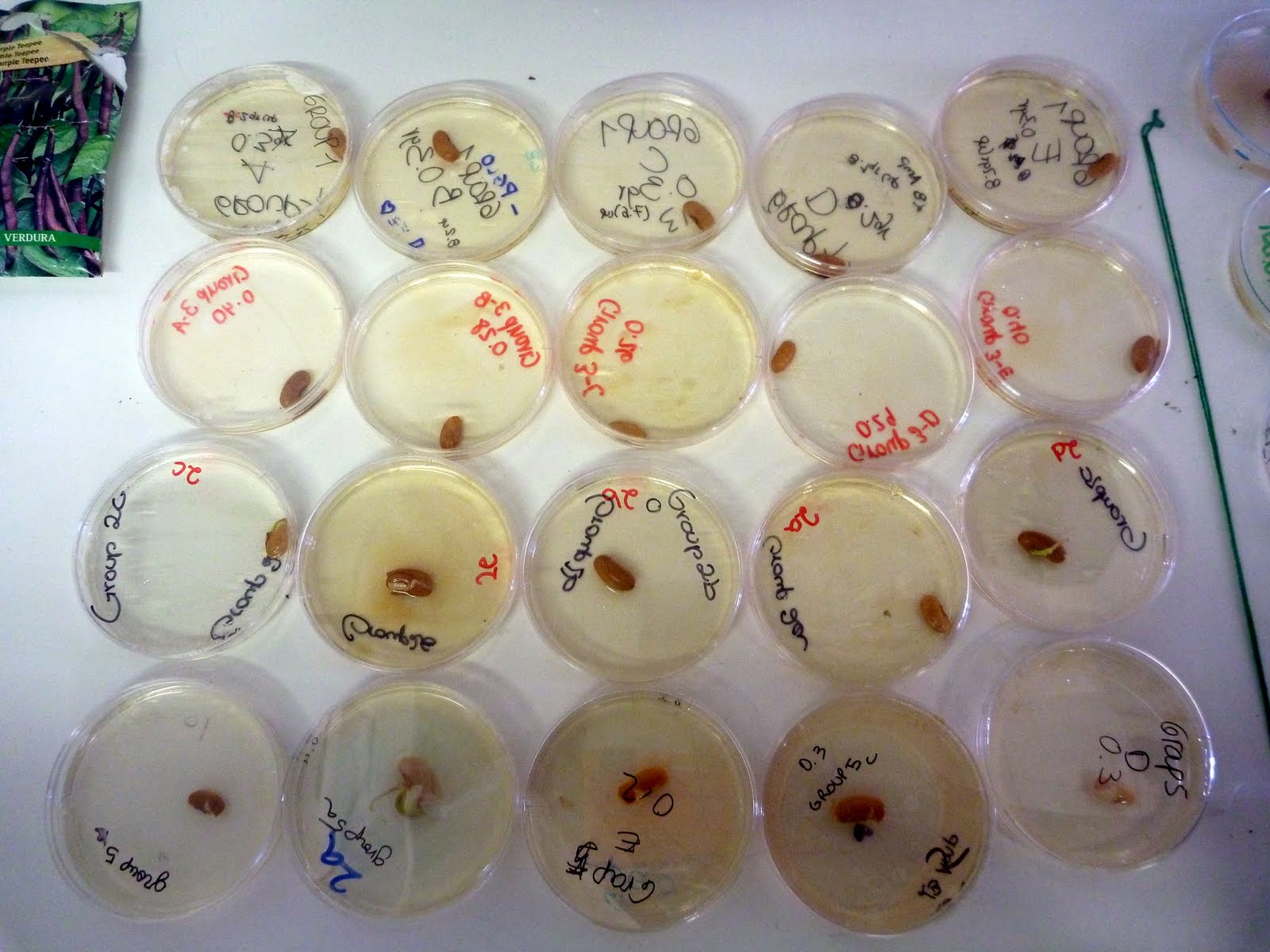
Picture 1: C period's experiment, a 4 x 5 set up.

Picture 2: A close up of two of the beans. On the left is an original purple bean, on the right is bean 5a.


After collecting the data, students practiced interpreting data and graphing sample data sets.

Homework:
Part 1: Complete the graphing packet (unless you already finished it in class).

Part 2: Complete the Book Tour. That's right, introduce yourself to your textbook. You will leave this book at home for the majority of the year.

Sunday, September 11, 2011

Setting up the seeds & salt experiment

In class on Friday students worked together to set up the seeds and salt experiment. Tomorrow (or on Tuesday depending on when your class meets) you'll make predictions about the change in mass of the seeds and collect the data.

After collecting the data, we'll do several practice problems where you graph data.

Lastly, tomorrow you'll finally get your textbook, as by now you should know whether or not you will be staying in the class.

Tuesday, September 6, 2011

Experimental Design: Bean Seeds

Today (or Thursday for G period) students presented their redesigned Simpon's experiments. Congratulations to the Bart group in C period for winning the 100,000CHF grant to continue their research.

Due Friday for C and G period: Complete a detailed experimental design for the seed lab. On Friday we will be selecting an experimental design to actually do in class. We will have from Sept. 9 through Sept. 21st to collect data in this experiment.


PART 1: Complete the rest of the experimental set up. Important questions to think about are:
* What will your light source be? How close will the plants be to the light? How can do make sure all the plants receive equal light?

* How often will you collect data?

* Water evaporates. What will you do to compensate for this?

PART 2: Make a data table that you could use to record your data from this experiment. You do not need to create data, just make the table.

Monday, September 5, 2011

Welcome to Biology

Today we learned about controls and variables in experimental design with the help of the Simpsons.
Homework: Choose one of the experiments from the worksheet and redesign it in the 5 x 5 model. In class tomorrow you will present your experimental design to the class. Be prepared to defend your design.

Sunday, September 4, 2011

Syllabus

General Biology

2011-2012

Ms. Saxe

Text: Biology Student Edition with Manual, Miller & Levine, Pearson, Prentice Hall

Other Materials: 1 binder, divided into two sections

A minimum of 3 different colored highlighters, pens or markers.

Content: Biology is the branch of science devoted to the study of life. The course starts with building an understanding of the scientific method before moving on to investigating the cell and energy processes at the cellular and system levels. Moving forward we will delve into cellular reproduction, genetics and cancer. At last we will focus on evolution, populations and the environment. Throughout this course students will work on the following four sets of scientific inquiry skills:

A. Make observations, raise questions, and formulate hypotheses.

B. Design and conduct scientific investigations.

C. Analyze and interpret results of scientific investigations.

D. Communicate and apply the results of scientific investigations.

Office Hours: By appointment only. The best way to set up a time for extra help is by email.

Grading:

Homework/Reading Quizzes 25% Tests/Projects 30%

Quizzes 15% Lab work 20%

Classwork 10%

Semester grade: Coursework…..75% Final Exam……25%

Year grade: 1st semester…..45% 2nd semester...…55%

Integrity: Being honest with yourself, your classmates and your teacher. Don't take credit for work that isn't yours and ask for help when you need it.


Homework: Homework will be assigned almost every night and be incorporated into the following day’s class. A late assignment defeats the purpose of completing it. Therefore, late homework will not be accepted and will be graded as a zero. Assignments include, but are not limited to: worksheets; problem sets; readings; preparing for a discussion/presentation etc.


Make-up Work: You are responsible for obtaining missed assignments. If you know in advance you will be missing class for co-curriculars, an appointment etc. you should notify me in advance at least 2 days in advance.


Late Work Policy: As previously stated, late homework is not accepted. Late projects will be accepted up to three calendar days after the due date. However, each day that the project is late, 10% of the grade will be lost. After the third day the project will no longer be accepted.


Extensions: Extensions will not be given except in the event of extenuating circumstances, so plan your time wisely.


Attendance: Attendance is mandatory at all class meetings. You are expected to arrive on time in be in your seat with your homework and your notebook on your desk. A pattern of tardiness will be regarded as not meeting the expectations of the class and will affect your effort grade.


Class participation: In order to make the most progress in this class you will need to participate actively. Participating in class not only means sharing your ideas but also coming prepared and on time.


Notebook: Must be divided into two sections and have a table of contents:

You must keep a detailed table of contents for your notebook.


Class Rules:

· BE ON TIME!

· BE PREPARED! Bring the textbook, your notebook, highlighters and pens/pencils each day.

· BE PRESENT! Both in mind and body. Showing up for class doesn’t mean much if you are daydreaming.

· If you have an unexcused absence from class on the day of a test or quiz you will receive a zero.

· As soon as you need extra help, come find me. Don’t wait!


Outline of topics to be covered in the Fall Term:

N.B. The instructor reserves the right to amend the syllabus at anytime.

Wk.

Ch.

Themes

Labs / Projects

1

1

Scientific inquiry and methods


2

1 /2

Experimental design and measurement; starting basic chemistry for biology

Seeds & Salt

3

2

Basic chemistry for biology, properties of water, pH

Seeds & Salt

4

2

Macromolecules

Testing for Macromolecules

5

2

Enzymes & Lab report skills

Potato Catalase

6

7

Cell structure and function

Microscope work

7

7

Membranes & osmosis

Dialysis tubing

8

Academic Travel


9

8

Photosynthesis and Cellular Respiration


10

9

Cellular Respiration

Elodea & Snails

11

9/10

Wrap up Cellular Respiration, start Cell Growth

Microscope work

12

10

Mitosis, Cell Cycle & Cancer

Cancer presentations

13

36

Skeletal & Muscular Systems

Build a skeleton

14

35

Nervous System & NIH’s Drugs, Brain & Behavior


15

NIH

Drugs, Brain & Behavior


Thank you in advance for all of the hard work and learning that you are about to engage in.

Sincerely,

Ms. Saxe

Wednesday, June 1, 2011

Final Exams Have Been Graded

Fueled by a bathtub of Starbucks coffee, I've finished grading your final exams. If you want to know your grade, email me.

Good luck on the rest of your exams :)

Final Exam Today!

It's rainy and gross out, so going downtown to the lake shouldn't be a distraction for you while you take the exam :)

One final reminder:

If you are in G period, your exam is in M1

If you are in D or F period, your exam is in M11.

Good luck :) If your were unwise last night and stayed up with the aid of Red Bull, drink lots of water today!

Monday, May 30, 2011

Final Exam Breakdown

Here's the breakdown of your exam:

Evolution:
3 multiple choice questions
3 open response questions

Statistics:
1 open response question

Genetics:
12 multiple choice
2 open response

DNA:
14 multiple choice
5 open response

Macromolecules:
6 multiple choice
3 open response

1 free point question half way through the exam.

Friday, May 27, 2011

Review Quiz 3 & Wrapping Up Bioethics

Yesterday students had their final review quiz (see answers below). We also spent the past two days learning how scarce resources are allocated, specifically, organs. We debated on the criteria that should be used to determine who would receive an organ and who wouldn't. Today, using that criteria we looked at four different cases to debate who should receive the transplant.

The big take away, "This is hard! Everyone should be able to have an organ." Too bad it's not like that in real life.

Tuesday, May 24, 2011

Review Quiz 2 & a Debate

Today students had a review quiz on DNA replication, transcription and translation. After the quiz, students debated the issue of using enhancements in sports.

Students were given a list of statements to debate and chose the following:

G period debated: Does using enhancements in sports violate what people value most about sports?

D period debated: Is it fair for an individual to use an enhancement?

F period debated: Does using enhancements in sports violate what people value most about sports?


Tomorrow/Thursday we'll be taking a look at allocating scare resources in the case of organ transplants. On Friday you'll have a debate about allocating organs. Your next review quiz is on evolution.

Here are the answers for today's quiz. Click the picture to make it larger.

Monday, May 23, 2011

Review Quiz 1 & Bioethics

After completing the short review quiz (see questions and answers below), we examined four core ethical considerations from module 1 of the NIH's curriculum:

1. Respect for persons
2. Harms and benefits
3. Fairness
4. Authenticity

We read a case study about a high school athlete and his potential use of steroids. Tomorrow we will have a debate about steroid use in athletes and the ethical questions raised by the use of performance enhancing drugs.

Tomorrow your review quiz will be on chapter 12 & the packets that go along with it.

Click the picture to make the page full size.
This way you can check your answers.


Friday, May 20, 2011

No Book? No Final Exam!

You must either return your textbook or pay for it to take the final exam. Below are the book numbers that have been assigned to you. The book number is in a red square on the inside front cover. You must return YOUR book, not a book that belongs to someone else. Of course if you see a stray book in the dorm, snack bar or lost and found closet, please turn it in!

Click the picture to make it larger.

What is bioethics?

Today we started our last unit of the year, using the NIH's bioethics curriculum. At the end of the fall term we used the NIH's Drugs, Brain and Behavior curriculum and had lots of thought provoking discussions; I suspect this unit we be the same.

Our goal for today was to define 'ethics' and assess the difference between ethical, legal and scientific questions. We ended class today discussing the case of Oscar Pistorius, a double amputee who uses cheetah legs to run, addressing such questions as:
• Should the International Association of Athletic Federations (IAAF)
allow Oscar Pistorius to compete?
• Should artificial limbs be permitted in organized sports competitions?
• Should Pistorius be allowed to compete in the Olympics?
• What alterations to the human body create an unfair advantage?

Below is a clip of Pistorius at the Bejing Paraolympics in the 100 meter dash.


Homework: On Monday you will have a short (10-15) question quiz on genetics. The questions and answers will be posted on the blog at the end of the day so you can check your work. It's never too early to start studying, so go!

Thursday, May 19, 2011

Tabs!


Check it out! Below the title of the blog and our/my favorite educational quote are a series of tabs that organize all of the helpful links.

You'll find the information about the final exam under "General Information."

Need to brush up on evolution for the final exam? Click on the evolution tab and see what you'll find.

Wednesday, May 18, 2011

Chocolate Statistics


Chocolate statistics

Initial observations

Look at your chocolates. Which do you think has the greater mass, a Smartie or an M&M? Or do you think they have the same mass?

Now touch your chocolates and ask yourself the same question.

Create a Hypothesis 1 (H1) and a Null Hypothesis (H0 )

Data Collection

How many Smarties/ M&Ms do you think you would need to measure the mass of to collect enough data to be sure of your answer?

Measure the mass of your Smarties. Now do the same for your M&Ms.

Record the data in an appropriate table. Don’t forget to include the units and the uncertainties of your equipment.

Data Processing

Calculate the arithmetic mean mass for your Smarties.

Now do the same for your M&Ms.

Calculate the Standard Deviations.

Perform an unpaired t-test on your results.

Data Presentation

Draw a graph of your results. Include error bars.

Conclusion and Evaluation

Which hypothesis can you accept/reject and why?

What were the possible errors in your experiment?

Calculating Standard Deviation

The Standard deviation (SD, s or ) of the mean tells us how spread out the reading are ( the ‘spreadoutness’ of the data).

1. Calculate the mean

2. Measure the deviations

3. Square the deviations

4. Add the squared deviations

5. Divide by the number of samples minus 1

6. Square root the answer

Ask your math teacher to show you how to calculate the standard deviation on your calculator. Or…. Just use Excel :)

The unpaired t-test

Go to

http://www.graphpad.com/quickcalcs/ttest1.cfm

and enter your data.


Your analysis is due by the end of class on Friday.

Tuesday, May 17, 2011

Starting Review

Today students worked on test corrections and we reviewed genetics. The labels in the right side bar of the blog will be really helpful for reviewing for the final exam. Click on the genetics label to see everything we have done on that topic.

Tomorrow (or Thursday) depending on when you have class, we will be doing the Smarties vs. MMs lab. One person in your group should bring a computer to collect the data.

Monday, May 16, 2011

Data Manipulation in Excel

Today students finished graphing with Excel and learned how to add standard deviation bars. Tomorrow we'll go over the macromolecules test and do a bit of review for genetics.

Please bring a computer to class on Wednesday/Thursday so we can collect the data for the Smarties vs. MMs lab.

Friday, May 13, 2011

Test Today

Today students took a test on macromolecules and the properties of water. This test covered the BIG concepts we've been learning about for the past two weeks. Think of it as a warm up for the final exam. A few students who were absent will need to take the test on Monday, but if you were in class on Friday, you will be able to see your grade on Monday. On Tuesday we will go over the test.

And now, your homework....

By Monday at 3:35 PM, email me the answers to the following questions:

1. What assignment are you most proud of from this class and why?

2. How does this work demonstrate your skills and abilities in Biology?

3. What was challenging or interesting about this project?

4. If you had to do this again, what would you do differently?

5. What did you work the hardest on? Was it a specific project, studying for a test, learning to be organized etc?

6. What was the most interesting thing to learn about this spring term? In case you’ve forgotten all that we have done, look back through the blog archive.

7. What were the biggest challenges to your success in this class?

8. How did you work to overcome these challenges?

9. How have you changed as a student from the start of the year to now?

10. What can you teach others about Biology that you couldn't before?

11. Is there a skill that you learned in this class that can help you in other classes, if so what it it? (don't you dare write "nothing" because you are tired of writing.

Part 2:

What are three things you think I do well as a teacher?


What are three things (or areas) where you think I could improve as a teacher?
** I know that you folks weren't big fans of the test you took today as illustrated by the number of "OMG's" that were uttered in various languages. Consider that feedback received loud and clear, and try to think about other ways to improve the class for future students. **


What is one piece of advice you would give to students who are taking this class next year?


Anything else I should know?

Thursday, May 12, 2011

Test Tomorrow

Tomorrow you have your test on macromolecules and the properties of water.

Please bring your computer to class on Monday so we can finish the assignment from the post below.